Car insurance is not a single product. It is a collection of different coverages bundled together. Each coverage protects you against a specific type of loss. And each coverage has its own type of claim. When you are in an accident, the type of claim you file determines which part of your policy pays, how much you receive, and how the process works.
Many drivers do not understand the difference between claim types. They file a collision claim when they should file a comprehensive claim. They file a first party claim when they should file a third party claim. They mix up liability claims with medical payments claims. These mistakes can cost you money, delay your payment, or even cause your claim to be denied.
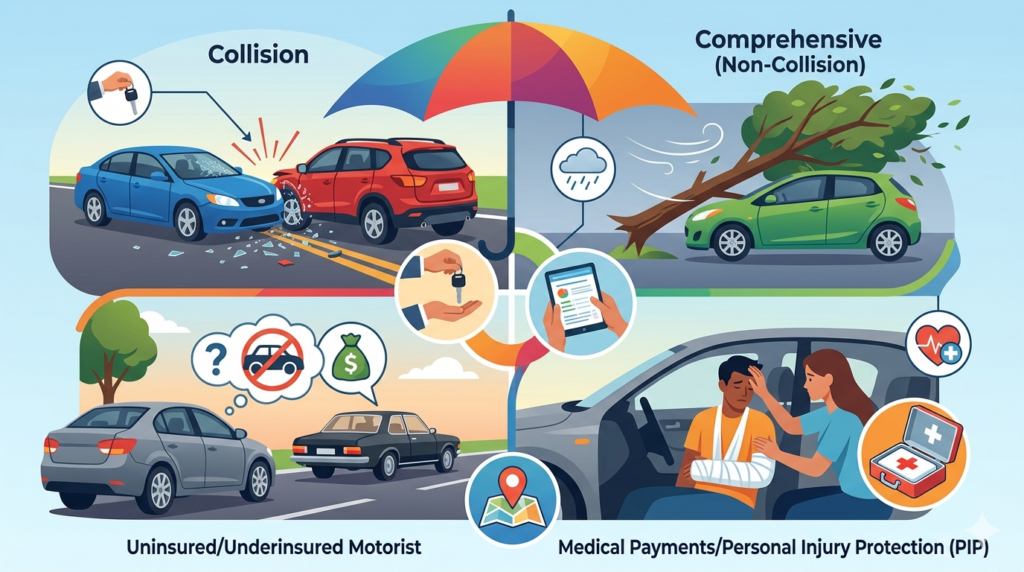
This article will explain the different types of car insurance claims. You will learn about first party claims versus third party claims. You will learn about collision claims, comprehensive claims, liability claims, uninsured motorist claims, medical payments claims, and more. You will learn when to file each type and what to expect. By the end, you will be able to identify the right claim for any situation.
First Party vs. Third Party Claims
Before diving into specific coverages, you need to understand the most basic distinction in insurance claims. First party claims are claims you file with your own insurance company. Third party claims are claims you file with the other driver’s insurance company.
Here is a table comparing first party and third party claims.
| Factor | First Party Claim (Your Insurer) | Third Party Claim (Other Driver’s Insurer) |
|---|---|---|
| Who you file with | Your own insurance company | The other driver’s insurance company |
| When to file | Always an option | Only if other driver is at fault |
| Deductible | You pay deductible (may be refunded later) | You pay no deductible |
| Speed | Usually faster | Often slower |
| Customer service | Your insurer works for you | Their insurer works for them |
| Premium impact | May increase your rates | Should not affect your rates |
| Disputes | You can appeal, use appraisal clause | You may need to sue |
Here is when to file a first party claim. If you have collision or comprehensive coverage, you can always file with your own insurer, regardless of fault. This is often faster because your insurer has a contractual obligation to you. You pay your deductible, but you may get it back later through subrogation.
Here is when to file a third party claim. If the other driver is clearly at fault and has adequate insurance, you can file with their insurer. You pay no deductible. However, the process is often slower because their insurer does not work for you. They work for their policyholder.
Many drivers file both. They file a first party claim with their own insurer to get paid quickly. Then their insurer subrogates against the other driver’s insurer to recover the money and refund the deductible.
Collision Claims
Collision claims are among the most common types of car insurance claims. Collision coverage pays for damage to your car when you hit something. That something could be another car, a tree, a pole, a guardrail, a building, or any other object.
Here is a table showing when to file a collision claim.
| Scenario | File Collision Claim? | Why |
|---|---|---|
| You rear end another car | Yes | You hit another vehicle |
| You hit a tree | Yes | You hit a stationary object |
| You back into a pole | Yes | You hit a stationary object |
| You lose control and hit a guardrail | Yes | You hit a stationary object |
| Another driver hits you | No | File with their liability or your collision as backup |
| You hit a deer | No | File comprehensive claim |
Collision claims always involve your car hitting something. The key word is hitting. If your car is the one doing the hitting, it is collision. If something hits your car, it may be comprehensive or liability depending on the situation.
Here is what to expect with a collision claim. You pay your collision deductible, typically $250 to $1,000. Your insurer pays for repairs up to the actual cash value of your car. If the repair cost exceeds a certain percentage of your car’s value, the car is totaled. You receive the actual cash value minus your deductible.
Collision claims often result in premium increases, especially if you are at fault. If the accident was not your fault, your rates may not increase. But some insurers increase rates for any claim, even not at fault. Check with your insurer.
Comprehensive Claims
Comprehensive claims cover damage to your car that is not caused by a collision. The name is misleading because comprehensive does not mean everything. It means everything except crashes.
Here is a table showing when to file a comprehensive claim.
| Scenario | File Comprehensive Claim? | Why |
|---|---|---|
| Hail damages your car | Yes | Weather damage |
| Tree falls on your car | Yes | Falling object |
| Your car is stolen | Yes | Theft |
| Someone vandalizes your car | Yes | Vandalism |
| You hit a deer | Yes | Animal strike |
| Flood damages your car | Yes | Weather damage |
| Fire damages your car | Yes | Fire |
| Windshield cracks from rock | Yes | Glass damage (often $0 deductible) |
Comprehensive claims do not involve your car hitting something. Instead, something hits your car or your car is damaged by nature, theft, or vandalism. The key distinction is collision versus comprehensive. If you hit something, it is collision. If something hits you or nature damages your car, it is comprehensive.
Here is what to expect with a comprehensive claim. You pay your comprehensive deductible, which is often lower than your collision deductible. Many drivers choose a $250 or $500 comprehensive deductible. Some policies offer $0 deductible glass coverage for windshield repairs.
Comprehensive claims are less likely to increase your premiums than collision claims. Insurers view comprehensive claims as less predictive of future risk. A hailstorm is not your fault. A stolen car is not your fault. However, multiple comprehensive claims may still raise your rates.
Liability Claims
Liability claims are different from collision and comprehensive claims. Liability coverage does not pay for damage to your car. It pays for damage you cause to other people and their property. Liability claims are filed against you by the other driver. Or you file a liability claim against the other driver if they are at fault.
Here is a table showing when liability claims are filed.
| Scenario | Who Files | What Is Covered |
|---|---|---|
| You cause an accident | Other driver files against you | Their car repairs, their medical bills |
| Other driver causes accident | You file against them | Your car repairs, your medical bills |
| You cause injury to passenger | Passenger files against you | Their medical bills |
| You damage property (fence, building) | Property owner files against you | Repair or replacement cost |
Liability claims have two components. Bodily injury liability pays for medical bills, lost wages, and pain and suffering for people you injure. Property damage liability pays for repairs to cars, fences, buildings, or anything else you damage.
Here is what to expect with a liability claim. You do not pay a deductible for liability coverage. Your insurer pays up to your policy limits. If the damages exceed your limits, you are personally responsible for the difference. This is why high liability limits are important.
If a liability claim is filed against you, your insurer will provide a lawyer to defend you. Cooperate fully with your insurer. Do not speak to the other driver’s insurer without your insurer present.
Uninsured and Underinsured Motorist Claims
Uninsured motorist claims are filed when you are hit by a driver who has no insurance. Underinsured motorist claims are filed when you are hit by a driver whose insurance limits are too low to cover your damages.
Here is a table showing when to file UM/UIM claims.
| Scenario | File UM/UIM Claim? | Why |
|---|---|---|
| Other driver has no insurance | Yes, UM claim | Their insurance pays nothing |
| Other driver has $15k limit, your damages are $50k | Yes, UIM claim | Their insurance pays $15k, yours pays $35k |
| Other driver has adequate insurance | No | Their insurance pays everything |
| Hit and run driver not identified | Yes, UM claim (in most states) | No other driver to claim against |
UM/UIM claims are filed with your own insurance company. They use your uninsured or underinsured motorist coverage. This coverage is relatively inexpensive, typically $5 to $15 per month, but it is essential.
Here is what to expect with a UM/UIM claim. You do not pay a deductible for bodily injury claims. For property damage, some states have a separate UMPD coverage with a small deductible. Your insurer pays for your medical bills, lost wages, and pain and suffering up to your UM/UIM limits.
UM/UIM claims should not increase your premiums because you are not at fault. However, some insurers increase rates for any claim. Check with your insurer.
Medical Payments and Personal Injury Protection Claims
Medical payments coverage (MedPay) and personal injury protection (PIP) pay for your medical bills after an accident, regardless of who is at fault. These claims are filed with your own insurance company.
Here is a table comparing MedPay and PIP claims.
| Factor | MedPay | PIP |
|---|---|---|
| What it pays | Medical bills only | Medical bills, lost wages, rehabilitation, funeral |
| Available in | All states | No fault states only |
| Deductible | No | Sometimes |
| Coordination with health insurance | Secondary | Primary or secondary depending on state |
Here is when to file a MedPay or PIP claim. You are injured in an accident, regardless of fault. You have medical bills. You want them paid quickly without waiting for fault determination. Your health insurance has a high deductible or does not cover accident injuries.
Here is what to expect with a MedPay or PIP claim. You submit your medical bills to your insurer. They pay promptly, often within weeks. There is no deductible in most policies. The coverage limits are typically $1,000 to $25,000.
MedPay and PIP claims should not increase your premiums because they are no fault coverages. However, filing multiple claims may raise red flags.
Rental Reimbursement Claims
Rental reimbursement coverage pays for a rental car while your car is being repaired after an accident. These claims are filed with your own insurance company.
Here is a table showing when rental reimbursement applies.
| Situation | Rental Reimbursement Covers? | Notes |
|---|---|---|
| Your car is being repaired after accident | Yes | Up to your daily and total limits |
| Your car is totaled | Yes, for a few days | Until settlement is paid |
| Your car is in shop for maintenance | No | Not accident related |
| Your car is stolen | Yes, if you have comprehensive | Until car is recovered or settled |
| You need a rental for vacation | No | Not accident related |
Here is what to expect with a rental reimbursement claim. You rent a car from a agency. You pay upfront or have the insurer pay directly. You are reimbursed up to your daily limit, typically $30 to $50 per day, for up to 30 days. You are responsible for any amount over your daily limit.
Rental reimbursement claims are low value and rarely affect your premiums. The coverage is inexpensive, typically $20 to $40 per year.
Roadside Assistance Claims
Roadside assistance coverage pays for services when your car breaks down. Towing, jump starts, lockout service, flat tire changes, and fuel delivery are typically covered.
Here is a table showing when roadside assistance applies.
| Service | Covered? | Typical Limit |
|---|---|---|
| Towing | Yes | $50-$150 or 5-15 miles |
| Jump start | Yes | No limit |
| Lockout service | Yes | Up to $50-$100 |
| Flat tire change | Yes | Use your spare |
| Fuel delivery | Yes | Up to 2-5 gallons |
Here is what to expect with a roadside assistance claim. You call the insurer’s 800 number. They dispatch a service provider. You pay nothing or a small copay. The service is billed directly to your insurer.
Important note. Some insurers count roadside assistance calls as claims. If you use roadside assistance multiple times, your rates may increase or your policy may be non-renewed. For frequent users, AAA may be a better option because it does not affect your insurance record.
Glass Claims
Glass claims are a subset of comprehensive claims. They cover damage to your windshield, side windows, rear window, and sunroof. Many insurers offer $0 deductible glass coverage.
Here is a table showing when glass claims apply.
| Damage | Covered? | Deductible |
|---|---|---|
| Windshield crack from rock | Yes | Often $0 with separate glass coverage |
| Windshield crack from accident | Yes | Standard comprehensive deductible |
| Side window broken by thief | Yes | Standard comprehensive deductible |
| Rear window shattered by hail | Yes | Standard comprehensive deductible |
| Cracked windshield from temperature change | Yes | Often $0 with separate glass coverage |
Here is what to expect with a glass claim. If you have $0 glass coverage, you pay nothing. The insurer pays for repair or replacement. If you have standard comprehensive coverage, you pay your comprehensive deductible. Some insurers require you to use specific glass shops.
Glass claims are common and generally do not affect your premiums, especially if you have $0 glass coverage. However, multiple glass claims may raise questions.
Gap Insurance Claims
Gap insurance claims are filed when your car is totaled and you owe more on your loan than the car is worth. Gap insurance pays the difference.
Here is a table showing when gap insurance applies.
| Situation | Gap Insurance Pays? | Amount |
|---|---|---|
| Car value $20k, loan balance $25k, car totaled | Yes | $5,000 |
| Car value $20k, loan balance $15k, car totaled | No | No gap |
| Car value $20k, loan balance $20k, car totaled | No | No gap |
Here is what to expect with a gap insurance claim. First, your collision or comprehensive claim pays the actual cash value of your car. Then your gap insurance pays the difference between that amount and your loan balance. You receive nothing directly. The payment goes to your lender.
Gap insurance claims are filed after your primary claim is settled. You need to provide your loan balance and the insurer’s total loss settlement. Gap insurance is inexpensive, typically $20 to $40 per year, and it can save you thousands.
Real Example: Multiple Claim Types in One Accident
Let us walk through a real example to see how different claim types work together in a single accident. Meet Sarah. She is stopped at a red light. A distracted driver rear ends her. The other driver has no insurance. Sarah’s car is damaged. Sarah has whiplash.
Here are the claim types Sarah files.
First, Sarah files an uninsured motorist claim for her injuries. The other driver has no insurance, so Sarah’s UM coverage pays for her medical bills, lost wages, and pain and suffering.
Second, Sarah files a collision claim for her car damage. She has collision coverage. She pays her $500 deductible. Her insurer pays for repairs. Later, her insurer may try to recover from the other driver through subrogation. If successful, Sarah gets her deductible back.
Third, Sarah files a rental reimbursement claim. While her car is being repaired, she needs a rental. Her policy pays $30 per day for up to 30 days.
Fourth, Sarah files a medical payments claim. Her MedPay coverage pays her medical bills immediately while she waits for the UM claim to process.
One accident. Four different claim types. Each serves a different purpose. Together, they make Sarah whole again.
The Bottom Line on Understanding the Different Types of Car Insurance Claims
Car insurance claims come in many types. Collision claims cover damage when you hit something. Comprehensive claims cover damage from theft, weather, vandalism, and animal strikes. Liability claims cover damage you cause to others. Uninsured and underinsured motorist claims cover you when the other driver has no insurance or not enough. Medical payments and PIP claims cover your medical bills regardless of fault. Rental reimbursement covers a rental car while yours is repaired. Roadside assistance covers breakdowns. Glass claims cover windshield damage. Gap insurance covers the difference when you owe more than your car is worth.
Each claim type has its own rules, its own deductible, and its own impact on your premiums. Knowing which type to file and when is essential to getting the money you deserve.
The best time to understand these claim types is before you need them. Review your policy. Know your deductibles. Know your coverage limits. Know what is covered and what is not. When an accident happens, you will be prepared. You will file the right claim. You will get paid faster. And you will avoid costly mistakes.