If you are a student or a young driver, you already know the bad news. Car insurance is expensive for you. Very expensive. The statistics are not on your side. Young drivers have higher accident rates than any other age group, and insurance companies charge accordingly. A teenager or college student can easily pay two thousand, three thousand, or even four thousand dollars per year for coverage that costs their parents half as much.
But here is the good news. There are legitimate, proven ways to get cheap car insurance as a student or young driver. You do not have to accept high rates as inevitable. By understanding which factors matter most to insurers, which discounts you qualify for, and how to structure your coverage, you can dramatically reduce your premium. Some young drivers save hundreds of dollars per year. Others save thousands.
This article will show you exactly how to get cheap car insurance for students and young drivers. You will learn why young drivers pay more, which insurers offer the best rates for your age group, which discounts you are probably missing, and the specific strategies that work for students living at home, living on campus, or driving their own car. By the end, you will have a clear action plan for paying less.
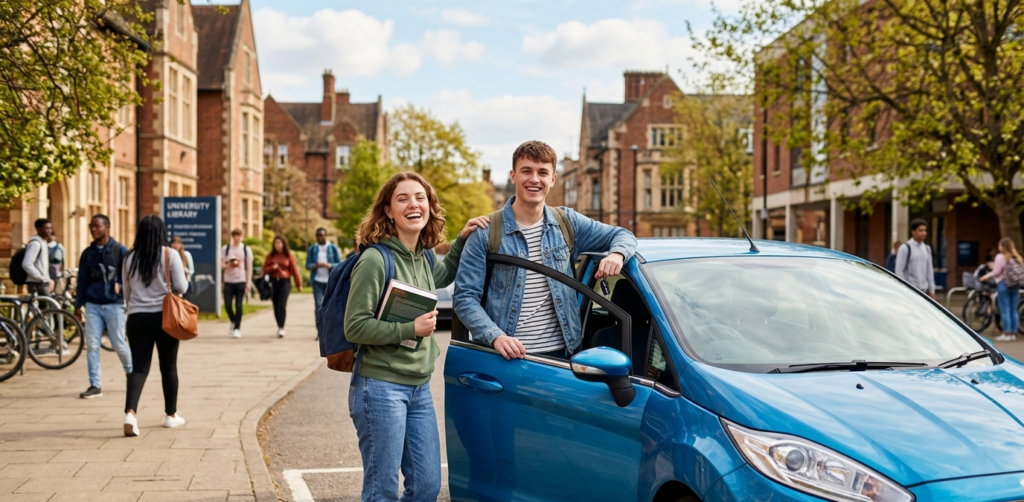
Why Young Drivers Pay More for Car Insurance
Before you can find cheap car insurance as a young driver, you need to understand why you are paying so much in the first place. The answer is not personal. It is statistical. Insurance companies do not hate young people. They just know the numbers.
Drivers between the ages of sixteen and twenty five have significantly higher accident rates than any other age group. They are more likely to speed, more likely to drive late at night, more likely to be distracted by passengers or phones, and less experienced at recognizing and avoiding dangerous situations. The result is that young drivers file more claims, and those claims are more expensive.
Here is a table showing how accident rates vary by age.
| Age Group | Accident Rate per Million Miles Driven | Compared to Drivers 30-59 |
|---|---|---|
| 16-17 | 10x higher | +900% |
| 18-19 | 7x higher | +600% |
| 20-24 | 3x higher | +200% |
| 25-29 | 1.5x higher | +50% |
| 30-59 | Baseline | 0% |
| 60-69 | 1.2x higher | +20% |
| 70+ | 2x higher | +100% |
As the table shows, a sixteen year old driver is ten times more likely to have an accident than a driver in their thirties. That is why their insurance premium is so high. But the good news is that rates drop quickly with age and experience. By age twenty, the accident rate is only three times higher. By age twenty five, it is almost down to the adult baseline.
Here is a table showing average annual premiums for young drivers with a clean record and a typical car.
| Age | Average Annual Premium | Compared to Age 30 |
|---|---|---|
| 16 | $3,800 | +217% |
| 17 | $3,400 | +183% |
| 18 | $3,000 | +150% |
| 19 | $2,700 | +125% |
| 20 | $2,400 | +100% |
| 21 | $2,100 | +75% |
| 22 | $1,900 | +58% |
| 23 | $1,750 | +46% |
| 24 | $1,600 | +33% |
| 25 | $1,450 | +21% |
| 30 | $1,200 | 0% |
Every year you drive without an accident, your rates will drop. The biggest drops happen at age twenty one and again at age twenty five. If you maintain a clean record, your insurance costs will decrease significantly over time.
Strategy One: Stay on Your Parents’ Policy
The single most effective way for a student or young driver to get cheap car insurance is to stay on their parents’ policy. A young driver on their own policy pays the rates shown in the table above, which can be three thousand dollars or more per year. The same driver added to a parent’s policy typically adds one thousand to two thousand dollars to the parent’s premium.
Here is a table comparing the cost of a separate policy versus being added to a parent’s policy.
| Age | Separate Policy Annual Premium | Added to Parent’s Policy (Additional Cost) | Savings from Staying on Parent’s Policy |
|---|---|---|---|
| 17 | $3,400 | $1,200 – $1,600 | $1,800 – $2,200 |
| 18 | $3,000 | $1,100 – $1,500 | $1,500 – $1,900 |
| 19 | $2,700 | $1,000 – $1,400 | $1,300 – $1,700 |
| 20 | $2,400 | $900 – $1,300 | $1,100 – $1,500 |
| 21 | $2,100 | $800 – $1,200 | $900 – $1,300 |
| 22 | $1,900 | $700 – $1,100 | $800 – $1,200 |
| 23 | $1,750 | $600 – $1,000 | $750 – $1,150 |
| 24 | $1,600 | $500 – $900 | $700 – $1,100 |
The savings are enormous. A nineteen year old on their own policy might pay two thousand seven hundred dollars per year. The same driver added to a parent’s policy might add only one thousand two hundred dollars to the family premium. That is a saving of one thousand five hundred dollars per year.
If you are a student living away at college, you can usually stay on your parents’ policy as long as your permanent address is still their home. Many insurers allow students to remain on the family policy even if they are living in a dorm or off campus apartment. Tell your insurer about your living situation to make sure you are properly covered.
The only reason to get your own policy is if your parents have a poor driving record or if you need to establish your own insurance history for the future. For most young drivers, staying on the family policy is the best financial choice.
Strategy Two: Claim the Good Student Discount
The good student discount is one of the most valuable discounts available to students. If you are under twenty five and have a B average or higher, you can save fifteen to twenty five percent on your portion of the insurance premium. The discount applies to the student driver’s portion of the premium, which can be a significant amount.
Here is a table showing how much the good student discount can save you.
| Age | Premium Without Good Student | Premium With Good Student (20% discount) | Annual Savings |
|---|---|---|---|
| 17 | $1,400 (portion on parent’s policy) | $1,120 | $280 |
| 18 | $1,300 | $1,040 | $260 |
| 19 | $1,200 | $960 | $240 |
| 20 | $1,100 | $880 | $220 |
| 21 | $1,000 | $800 | $200 |
| 22 | $900 | $720 | $180 |
Over four years of college, the good student discount can save you over one thousand dollars. All you need is a report card or transcript showing a B average. Some insurers also require that you be a full time student, typically defined as twelve credit hours or more per semester.
If you are a high school student, the same discount applies. Maintain a B average and provide your report card to your insurer. The discount usually applies until age twenty five, as long as you are a full time student.
If your grades are not quite at a B average, consider working to improve them. The financial incentive of lower insurance rates is real. A few extra hours of studying each week could save you hundreds of dollars per year.
Here is the documentation you typically need to claim the good student discount.
| Documentation | Where to Get It | How Often to Submit |
|---|---|---|
| Report card | School website or guidance office | Every semester |
| Transcript | School registrar | Annually |
| Dean’s list letter | Academic dean’s office | As received |
| Honor roll certificate | School administration | As received |
Do not assume your insurer knows about your grades. You must provide documentation. Submit your report card as soon as you receive it. The discount usually applies from the date you submit the documentation.
Strategy Three: Take a Defensive Driving Course
A defensive driving course is one of the easiest ways for young drivers to lower their insurance rates. The course takes about six hours and can be completed entirely online for twenty five to fifty dollars. The discount typically lasts for three years and ranges from five to fifteen percent.
Here is a table showing the return on investment for a defensive driving course.
| Your Annual Premium | Discount | Annual Savings | Cost of Course | Net Savings First Year | Net Savings Over 3 Years |
|---|---|---|---|---|---|
| $1,200 | 10% | $120 | $50 | $70 | $310 |
| $1,500 | 10% | $150 | $50 | $100 | $400 |
| $1,800 | 10% | $180 | $50 | $130 | $490 |
| $2,100 | 10% | $210 | $50 | $160 | $580 |
| $2,500 | 10% | $250 | $50 | $200 | $700 |
The course pays for itself many times over. A fifty dollar investment saves you hundreds of dollars in insurance premiums. And the skills you learn can help you avoid accidents and tickets, which saves you even more money.
Many online defensive driving courses are state approved for insurance discounts. Before you take a course, check with your insurer to confirm that they accept it. Some insurers have a list of approved providers. Others accept any state approved course.
In addition to the insurance discount, a defensive driving course may also help you avoid points on your license if you receive a ticket. Some states allow drivers to take a defensive driving course to dismiss a minor violation. This keeps your record clean and prevents your rates from increasing.
Here are some reputable online defensive driving course providers.
| Provider | Cost | Time Required | State Availability |
|---|---|---|---|
| AAA | $25 – $35 | 6 hours | Most states |
| National Safety Council | $25 – $50 | 6 hours | Most states |
| Improv | $20 – $30 | 6 hours | Many states |
| Comedy Driving | $25 – $35 | 6 hours | Many states |
| DriveSafe Online | $25 – $40 | 6 hours | Most states |
Take the course, save the certificate, and submit it to your insurer. The discount will apply from that date forward.
Strategy Four: Choose a Cheap Car to Insure
The car you drive has a massive impact on your insurance premium. As a young driver, choosing the right car can save you hundreds or even thousands of dollars per year. The difference between a sports car and a sensible sedan is enormous for young drivers.
Here is a table showing insurance costs for different types of cars for an eighteen year old driver.
| Vehicle Type | Example Models | Annual Premium for 18 Year Old | Compared to Midsize Sedan |
|---|---|---|---|
| Midsize sedan | Honda Accord, Toyota Camry | $2,800 | Baseline |
| Small SUV | Honda CR-V, Toyota RAV4 | $2,900 | +$100 |
| Compact car | Honda Civic, Toyota Corolla | $2,700 | -$100 |
| Minivan | Honda Odyssey, Toyota Sienna | $2,950 | +$150 |
| Pickup truck | Ford F-150, Ram 1500 | $3,200 | +$400 |
| Entry luxury | BMW 3 Series, Audi A4 | $4,000 | +$1,200 |
| Sports car | Ford Mustang, Chevrolet Camaro | $4,500 | +$1,700 |
The eighteen year old driving a Ford Mustang pays one thousand seven hundred dollars more per year than the same driver in a Honda Civic. Both cars provide transportation. But one costs significantly more to insure.
If you are a student or young driver, choose a car with the following characteristics. Four doors instead of two. A four cylinder engine instead of six or eight cylinders. High safety ratings from the Insurance Institute for Highway Safety. Low theft rates. Affordable repair costs. Common models that are cheap to fix.
Here is a list of cars that are typically cheap to insure for young drivers.
| Make | Model | Why It Is Cheap |
|---|---|---|
| Honda | Civic | High safety, low theft, cheap parts |
| Honda | Accord | High safety, low theft, cheap parts |
| Toyota | Corolla | High safety, low theft, cheap parts |
| Toyota | Camry | High safety, low theft, cheap parts |
| Subaru | Outback | High safety, all-wheel drive |
| Subaru | Forester | High safety, all-wheel drive |
| Mazda | CX-5 | High safety, good crash tests |
| Ford | Escape | Common, cheap parts |
| Hyundai | Elantra | High safety, affordable |
If you are buying your first car, get insurance quotes before you make a purchase. Use the VIN of a car you are considering to get an accurate quote. The difference in insurance costs might influence your decision.
Strategy Five: Maintain a Clean Driving Record
This strategy sounds obvious, but its impact is larger than most young drivers realize. A single speeding ticket or at fault accident can raise your premium by thirty to fifty percent for three years. For a young driver already paying high rates, that is a massive increase.
Here is a table showing the true cost of a ticket or accident for a young driver.
| Violation | Premium Increase | Duration | Total Extra Cost for 19 Year Old Paying $2,700 |
|---|---|---|---|
| Minor speeding ticket | 20-30% | 3 years | $1,620 – $2,430 |
| Major speeding ticket | 30-40% | 3 years | $2,430 – $3,240 |
| At fault accident under $2,000 | 35-45% | 3 years | $2,835 – $3,645 |
| At fault accident over $2,000 | 45-60% | 3-5 years | $3,645 – $8,100 |
| DUI | 100-150%+ | 5+ years | $13,500 – $20,250+ |
That minor speeding ticket that costs you one hundred fifty dollars in fines could cost you over two thousand dollars in increased insurance premiums. The ticket is not worth it. Drive the speed limit.
Here are the most important safe driving habits for young drivers.
First, put your phone away. Distracted driving is one of the leading causes of accidents for young drivers. Put your phone in the glove compartment or use a do not disturb while driving feature. No text message is worth your life or your insurance rates.
Second, give yourself extra following distance. Young drivers often follow too closely. Use the four second rule. When the car in front of you passes a fixed object, count four seconds before you pass the same object. This gives you time to react.
Third, avoid late night driving. The risk of accidents is highest between midnight and 4 AM. If you can avoid driving during these hours, your risk decreases significantly. Some telematics programs also penalize night driving.
Fourth, limit your passengers. Young drivers with passengers are more likely to be distracted and more likely to take risks. Many states have graduated licensing laws that restrict passengers for young drivers. Follow those laws even if you think you are a good driver.
Fifth, never drive after drinking. A DUI is catastrophic for your insurance rates, your driving record, and your future. Do not do it. Uber is cheaper than a DUI.
Strategy Six: Use Telematics to Prove You Are a Safe Driver
Telematics programs use a smartphone app or a small device to monitor your driving habits. Safe drivers are rewarded with lower rates. For young drivers, telematics is especially valuable because you have no long term driving history to prove your safety. Telematics gives you a way to show insurers that you are better than the statistics.
Here is a table comparing telematics programs for young drivers.
| Program | How It Works | Typical Savings for Safe Young Drivers | Best Feature |
|---|---|---|---|
| Progressive Snapshot | Plug-in device or app for 6 months | $150 – $300+ per year | No penalty for safe driving |
| State Farm Drive Safe & Save | App or device, ongoing | Up to 30% | Immediate discount |
| Geico DriveEasy | App only, ongoing | Up to 25% | Low baseline rates |
| Allstate Drivewise | App only, ongoing | Up to 25% | Cash back rewards |
If you are a safe driver, telematics is not a risk. It is an opportunity. You drive safely. Now you can prove it and get paid for it. The discount you receive will reflect your actual driving habits.
Here are the key factors telematics tracks and how to optimize them.
Smooth braking is the most heavily weighted factor. Hard braking indicates aggressive driving or following too closely. Increase your following distance to brake more gradually.
Smooth acceleration is also important. Rapid acceleration from a stoplight signals aggressive driving. Accelerate gradually.
Phone use while driving is tracked by app based programs. If you touch your phone while the car is moving, you will be penalized. Put your phone away.
Low mileage is rewarded. The less you drive, the lower your risk. If you are a student living on campus, you may drive very few miles. Make sure your telematics program knows that.
For a young safe driver, telematics can reduce your premium by ten to forty percent. That is real money.
Strategy Seven: Living Away at College? Tell Your Insurer
If you are a student living away at college, you may qualify for a discount. Many insurers offer a student away at college discount for young drivers who live more than one hundred miles from home and do not have a car with them on campus.
Here is how it works. If you are a student on your parents’ policy and you are living at college without a car, your risk to the insurer is very low. You are not driving. Your parents are still paying for you on the policy, but you are not actually using the car. Many insurers recognize this and offer a discount of ten to thirty percent on your portion of the premium.
Here is a table showing potential savings from the student away discount.
| Age | Normal Premium (on parent’s policy) | Student Away Discount (20%) | Annual Savings |
|---|---|---|---|
| 18 | $1,300 | $1,040 | $260 |
| 19 | $1,200 | $960 | $240 |
| 20 | $1,100 | $880 | $220 |
| 21 | $1,000 | $800 | $200 |
If you are bringing a car to campus, you do not qualify for this discount. But you still need to tell your insurer where the car will be parked. Insurance rates vary by zip code. If your college is in a different city than your parents’ home, your rate may change. It could go up or down depending on the accident and theft rates in that area.
Always tell your insurer where your car will be parked most of the time. If you do not, and you file a claim, the insurer may deny coverage because you misrepresented your location.
Strategy Eight: Comparison Shop Every Six Months
Young drivers should never assume they have the best rate. Insurance rates change constantly, and different insurers weigh young driver risk differently. The company that had the best rate for you at seventeen may not have the best rate at nineteen.
Set a calendar reminder for every six months. Spend one hour getting quotes from at least five insurers. Use the same coverage limits on every quote. Compare the results.
Here is a table showing how much young drivers can save by shopping around.
| Age | Average Premium | Lowest Possible Premium for a Safe Young Driver | Potential Savings |
|---|---|---|---|
| 18 | $3,000 | $2,400 | $600 |
| 19 | $2,700 | $2,200 | $500 |
| 20 | $2,400 | $2,000 | $400 |
| 21 | $2,100 | $1,750 | $350 |
| 22 | $1,900 | $1,600 | $300 |
Do not assume your current insurer is giving you the best rate. They are counting on your inertia. Prove them wrong.
Real Example: How a Student Saved $1,400 Per Year
Let us walk through a real example to see how these strategies work together. Meet Sarah, a nineteen year old college student in Illinois. She is a full time student with a 3.6 GPA. She has a clean driving record. She drives a 2018 Honda Civic. She is currently on her parents’ policy, and her portion of the premium is two thousand four hundred dollars per year.
Sarah wants to get cheap car insurance. She follows these steps.
First, she claims the good student discount. Her parents provide her report card to the insurer. Her portion of the premium drops from two thousand four hundred dollars to one thousand nine hundred twenty dollars, a savings of four hundred eighty dollars per year.
Second, she completes a defensive driving course online for fifty dollars. Her insurer applies a ten percent discount to her portion of the premium. Her premium drops from one thousand nine hundred twenty dollars to one thousand seven hundred twenty eight dollars, a savings of one hundred ninety two dollars per year.
Third, she signs up for her insurer’s telematics program. As a safe driver, she receives a fifteen percent discount after the monitoring period. Her premium drops from one thousand seven hundred twenty eight dollars to one thousand four hundred sixty nine dollars, a savings of two hundred fifty nine dollars per year.
Fourth, she tells her insurer that she is living at college without a car. She is a commuter student living at home, so she does not qualify for the student away discount. But her insurer offers a low mileage discount because she drives only six thousand miles per year. Her premium drops from one thousand four hundred sixty nine dollars to one thousand three hundred ninety five dollars, a savings of seventy four dollars per year.
Fifth, her parents shop around for a new policy at renewal. They find that Travelers offers the same coverage for a family premium that is four hundred dollars lower overall. Sarah’s portion of the new premium is one thousand one hundred ninety dollars.
Sarah’s original premium was two thousand four hundred dollars. Her new premium is one thousand one hundred ninety dollars. She saved one thousand two hundred ten dollars per year, or one hundred one dollars per month. She did not sacrifice any protection. She simply used the strategies that work for students and young drivers.
The Bottom Line on Cheap Car Insurance for Students and Young Drivers
Being a young driver is expensive. The statistics are not in your favor, and insurance companies charge accordingly. But you are not powerless. There are legitimate, proven ways to get cheap car insurance as a student or young driver.
Stay on your parents’ policy. This is the single biggest money saver. A young driver on their own policy pays dramatically more than one added to a family policy.
Claim the good student discount. If you have a B average, you can save fifteen to twenty five percent. Provide your report card to your insurer every semester.
Take a defensive driving course. The course costs fifty dollars and saves hundreds over three years. It also makes you a safer driver.
Choose a cheap car to insure. Four doors, four cylinders, high safety ratings, and affordable repair costs. Avoid sports cars and luxury vehicles.
Maintain a clean driving record. A single ticket or accident can cost you thousands in increased premiums. Drive safely.
Use telematics to prove your safe driving. You have no long term history. Telematics gives you a way to show insurers that you are better than the statistics.
Tell your insurer if you are living away at college without a car. You may qualify for a discount.
Comparison shop every six months. Do not assume your current insurer has the best rate. Get quotes from at least five insurers.
The strategies in this article work. They have saved thousands of young drivers hundreds or thousands of dollars per year. They can work for you too. Start today. Claim your discounts. Take a defensive driving course. Shop around. Your wallet will thank you.