Every driver wants to pay less for car insurance. But most drivers only know about the basic discounts. Safe driver, good student, maybe bundling. They assume that if they qualify for those, they have already gotten the best possible rate. That assumption is costing them hundreds of dollars per year.
The truth is that there are dozens of car insurance discounts available. Some are well known. Others are hidden in the fine print. Some apply automatically. Others require you to ask. The smart driver knows how to find every discount they qualify for and claim it. The result is a significantly lower insurance bill without changing a single thing about their coverage.
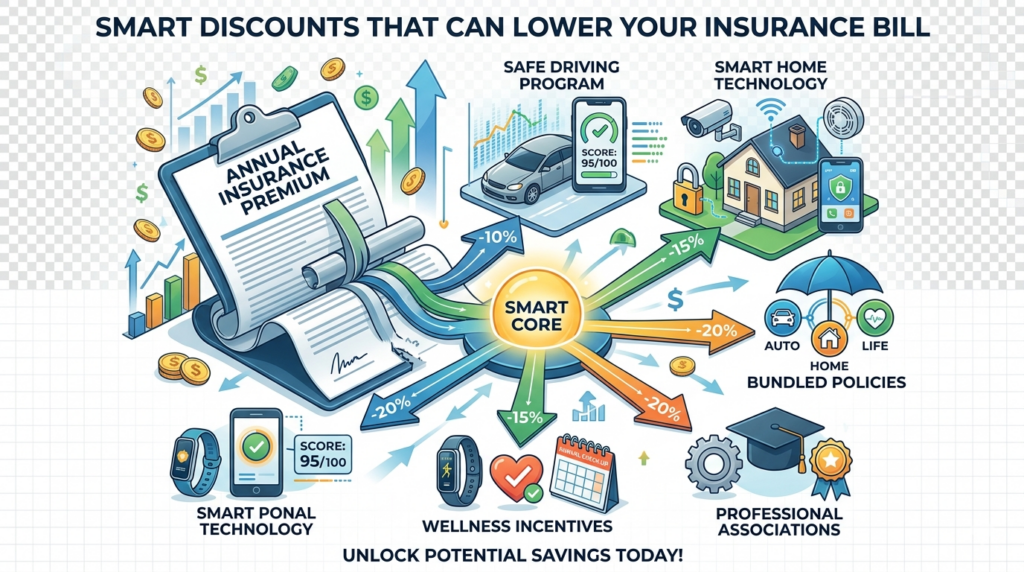
This article will reveal the smart discounts that can lower your insurance bill. You will learn about common discounts you might be missing, uncommon discounts you have probably never heard of, and how to stack multiple discounts for maximum savings. By the end, you will have a complete checklist of discounts to ask for, and you will be able to lower your premium without sacrificing protection.
The Safe Driver Discount: Your Most Valuable Asset
The safe driver discount is the foundation of low insurance rates. It rewards drivers who have maintained a clean driving record for a certain period, typically three to five years. The discount can be ten to twenty five percent or more, depending on the insurer.
Here is a table showing how the safe driver discount grows with each year of clean driving.
| Years Accident and Ticket Free | Typical Discount | Annual Premium on $1,500 Baseline |
|---|---|---|
| 0 (recent accident) | 0% or surcharge | $1,500 – $2,250 |
| 1 year | 5-10% | $1,350 – $1,425 |
| 2 years | 10-15% | $1,275 – $1,350 |
| 3 years | 15-20% | $1,200 – $1,275 |
| 4 years | 20-25% | $1,125 – $1,200 |
| 5+ years | 25-30% | $1,050 – $1,125 |
Most drivers assume this discount is applied automatically. It usually is. But you should still verify. Check your policy declarations page or ask your agent. Some insurers require you to have a clean record for a specific number of years before the discount applies. If you have recently reached a milestone, like three or five years accident free, call and confirm that your discount has been updated.
If you have a minor violation on your record, ask when it will fall off. Most violations stay on your record for three years. Once that time has passed, call your insurer and ask them to recalculate your rate. They will not do this automatically. You have to ask.
The Bundling Discount: Two Policies for Less Than One
Bundling is one of the most powerful discounts available. When you purchase multiple policies from the same insurer, such as car insurance and renters insurance or car insurance and homeowners insurance, you qualify for a bundling discount. The discount is typically ten to twenty five percent on both policies.
Here is a table showing the savings from bundling.
| Policies Bundled | Typical Discount | Annual Car Premium (Standalone) | Annual Car Premium (Bundled) | Annual Home/Renters Premium | Total Savings |
|---|---|---|---|---|---|
| Car + renters | 10-15% | $1,500 | $1,275 – $1,350 | $150 | $225 – $375 |
| Car + homeowners | 15-25% | $1,500 | $1,125 – $1,275 | $1,000 | $225 – $425 |
| Car + renters + umbrella | 15-20% | $1,500 | $1,200 – $1,275 | $150 + $200 | $375 – $500 |
The best part about bundling is that the second policy often pays for itself. A renters insurance policy might cost one hundred fifty dollars per year. But the bundling discount on your car insurance might save you two hundred dollars per year. Your net cost for renters insurance is negative fifty dollars. You get free protection for your belongings plus liability coverage.
If you already have a homeowners or renters policy with one insurer, get a car insurance quote from that same insurer. If you already have car insurance, get a quote for renters insurance from the same company. The bundled price is almost always lower than what you are paying separately.
If you are a student living in a dorm, your parents’ homeowners policy may already cover your belongings. Check before buying a separate renters policy. But if you live in an off campus apartment, renters insurance is a smart purchase anyway, and the bundling discount makes it even smarter.
The Good Student Discount: Rewarding Academic Excellence
The good student discount is one of the most valuable discounts for families with teenage or young adult drivers. If you are under twenty five and have a B average or higher, you can save fifteen to twenty five percent on your portion of the insurance premium.
Here is a table showing the value of the good student discount over time.
| Age | Premium Without Good Student | Premium With Good Student (20% discount) | Annual Savings | Savings Over 4 Years of College |
|---|---|---|---|---|
| 18 | $1,300 | $1,040 | $260 | $1,040 |
| 19 | $1,200 | $960 | $240 | $960 |
| 20 | $1,100 | $880 | $220 | $880 |
| 21 | $1,000 | $800 | $200 | $800 |
| Total | $3,680 |
Almost four thousand dollars in savings just for maintaining a B average. That is a powerful incentive to study.
The discount is not automatic. You must provide documentation. Submit your report card or transcript to your insurer every semester. Some insurers also require that you be a full time student, typically defined as twelve credit hours or more per semester.
If you are a high school student, the same discount applies. Maintain a B average and provide your report card. The discount usually applies until age twenty five, as long as you are a full time student.
If you are a parent, make sure your insurer knows about your child’s grades. Do not assume they have the information. Submit the documentation yourself.
Here is a table of documentation accepted for the good student discount.
| Documentation | Where to Get It | How Often |
|---|---|---|
| Report card | School website or guidance office | Every semester |
| Transcript | School registrar | Annually |
| Dean’s list letter | Academic dean’s office | As received |
| Honor roll certificate | School administration | As received |
| GPA verification form | Insurer’s website (sometimes) | Annually |
The Defensive Driving Discount: Small Investment, Big Return
A defensive driving course is one of the easiest ways to lower your insurance bill. The course takes about six hours and can be completed entirely online for twenty five to fifty dollars. The discount typically lasts for three years and ranges from five to fifteen percent.
Here is a table showing the return on investment for a defensive driving course.
| Your Annual Premium | Discount | Annual Savings | Cost of Course | Net Savings First Year | Net Savings Over 3 Years |
|---|---|---|---|---|---|
| $1,000 | 10% | $100 | $50 | $50 | $250 |
| $1,200 | 10% | $120 | $50 | $70 | $310 |
| $1,500 | 10% | $150 | $50 | $100 | $400 |
| $1,800 | 10% | $180 | $50 | $130 | $490 |
| $2,000 | 10% | $200 | $50 | $150 | $550 |
| $2,500 | 10% | $250 | $50 | $200 | $700 |
The course pays for itself many times over. A fifty dollar investment saves you hundreds of dollars in insurance premiums. And the skills you learn can help you avoid accidents and tickets, which saves you even more money.
Many online defensive driving courses are state approved for insurance discounts. Before you take a course, check with your insurer to confirm that they accept it. Some insurers have a list of approved providers. Others accept any state approved course.
In addition to the insurance discount, a defensive driving course may also help you avoid points on your license if you receive a ticket. Some states allow drivers to take a defensive driving course to dismiss a minor violation. This keeps your record clean and prevents your rates from increasing.
Here are some reputable online defensive driving course providers.
| Provider | Cost | Time Required | Best For |
|---|---|---|---|
| AAA | $25 – $35 | 6 hours | Members get additional discount |
| National Safety Council | $25 – $50 | 6 hours | Widely accepted |
| Improv | $20 – $30 | 6 hours | Engaging format |
| Comedy Driving | $25 – $35 | 6 hours | Humorous approach |
| DriveSafe Online | $25 – $40 | 6 hours | Mobile friendly |
Take the course, save the certificate, and submit it to your insurer. The discount will apply from that date forward.
The Low Mileage Discount: Pay Less for Driving Less
The less you drive, the less risk you pose to your insurer. Drivers who drive fewer miles have fewer opportunities to have accidents. Most insurers offer a low mileage discount for drivers who drive less than seven thousand five hundred or ten thousand miles per year.
Here is a table showing how annual mileage affects your premium.
| Annual Mileage | Typical Discount | Annual Premium on $1,500 Baseline |
|---|---|---|
| 15,000+ | 0% | $1,500 |
| 12,000 | 0% | $1,500 |
| 10,000 | 0% | $1,500 |
| 9,000 | 5% | $1,425 |
| 7,500 | 10-12% | $1,320 – $1,350 |
| 5,000 | 15-18% | $1,230 – $1,275 |
| 3,000 | 18-25% | $1,125 – $1,230 |
The driver who works from home and drives three thousand miles per year pays almost four hundred dollars less than the driver who commutes fifty miles each day. That is a significant difference for the same coverage.
The problem is that many drivers overestimate how many miles they drive. They guess twelve thousand miles per year because that is the average. But their actual mileage might be much lower. If you have not checked your odometer recently, you are likely paying too much.
Here is how to calculate your actual annual mileage. Write down your odometer reading today. Write down the date. One year from today, write down your odometer reading again. Subtract the first number from the second. That is your annual mileage. If you cannot wait a year, track your mileage for one typical week, multiply by fifty two, and add a buffer for road trips.
If your actual mileage is lower than what your insurer has on file, call them and update it. This one phone call can save you five to fifteen percent immediately.
The Pay in Full Discount: Save by Paying Annually
Most insurers offer a discount for paying your annual premium in full rather than in monthly installments. The discount is typically five to fifteen percent. In addition, you avoid monthly installment fees, which can be five to ten dollars per month.
Here is a table comparing the cost of monthly payments versus annual payment.
| Annual Premium | Monthly Payment (with $10 fee) | Total Annual Cost with Monthly | Savings from Paying in Full |
|---|---|---|---|
| $1,200 | $110 | $1,320 | $120 |
| $1,500 | $135 | $1,620 | $120 |
| $1,800 | $160 | $1,920 | $120 |
| $2,100 | $185 | $2,220 | $120 |
| $2,400 | $210 | $2,520 | $120 |
| $3,000 | $260 | $3,120 | $120 |
The savings from paying in full come from two sources. First, you avoid monthly installment fees, typically five to ten dollars per month. Second, you qualify for the pay in full discount, typically five to fifteen percent of the annual premium.
If you cannot afford to pay the entire annual premium at once, consider opening a separate savings account. Each month, deposit what you would have paid to the insurer. At the end of the year, use that money to pay the next year’s premium in full. After the first year, you are effectively paying monthly but receiving the annual discount.
Some insurers offer a pay in half option, where you pay twice per year. This still saves you money compared to monthly payments, though not as much as paying annually.
The Automatic Payment and Paperless Discounts
These are small discounts, but they add up. Many insurers offer a discount for setting up automatic payments from your bank account or credit card. The discount is typically five to ten percent. They also offer a smaller discount, usually three to five percent, for switching to paperless billing.
Here is a table showing the combined value of these small discounts.
| Discount | Typical Savings | Annual Savings on $1,500 Premium |
|---|---|---|
| Automatic payment | 5-10% | $75 – $150 |
| Paperless billing | 3-5% | $45 – $75 |
| Combined | 8-15% | $120 – $225 |
These discounts require almost no effort. Set up autopay once, and you never have to think about paying your bill again. Switch to paperless billing, and you stop receiving paper mail. Both are good for the environment and good for your wallet.
The only caution with automatic payment is to make sure you have enough funds in your account on the billing date. A bounced payment can result in fees and could even cause your policy to be canceled. Set a calendar reminder for a few days before the payment date to check your balance.
The Occupation and Affiliation Discounts
Your job and your memberships can lower your insurance bill. Many insurers offer discounts for certain occupations, including teachers, nurses, engineers, accountants, scientists, law enforcement officers, firefighters, and military personnel. The discount is typically five to fifteen percent.
Here is a table showing common occupation discounts.
| Occupation | Typical Discount | How to Claim |
|---|---|---|
| Teacher | 5-10% | Tell insurer your job title |
| Nurse | 5-10% | Tell insurer your job title |
| Engineer | 5-15% | Tell insurer your job title |
| Accountant | 5-10% | Tell insurer your job title |
| Law enforcement | 10-15% | Tell insurer, may need proof |
| Firefighter | 10-15% | Tell insurer, may need proof |
| Military (active or veteran) | 15-25% | Provide military ID or DD214 |
Many insurers also offer discounts for members of certain professional organizations, alumni associations, or even specific employers. Geico, for example, offers discounts to members of over five hundred organizations, including many professional associations, alumni groups, and corporate partners.
Here is a table showing common affiliation discounts.
| Affiliation | Typical Discount | How to Claim |
|---|---|---|
| Alumni association | 5-15% | Provide membership information |
| Professional organization | 5-15% | Provide membership card |
| Credit union member | 5-10% | Show credit union card |
| Costco member | 5-15% (through Connect) | Shop through Costco |
| AAA member | 5-15% | Provide membership number |
| AARP member | 5-15% | Provide membership number |
Do not assume you do not qualify. Ask your agent, “Do you offer any discounts for my occupation or for members of any organizations?” You might be surprised by the answer.
The Anti-Theft and Safety Feature Discounts
If your car has anti-theft devices or advanced safety features, you may qualify for additional discounts. Anti-theft devices like alarms, tracking systems, and immobilizers reduce the risk of theft. Safety features like automatic emergency braking, lane departure warnings, and blind spot monitoring reduce the risk of accidents.
Here is a table showing common anti-theft and safety feature discounts.
| Feature | Typical Discount | Which Cars Have It |
|---|---|---|
| Car alarm | 5-10% | Many new cars, aftermarket |
| GPS tracking (LoJack, OnStar) | 10-15% | Some new cars, aftermarket |
| Engine immobilizer | 5-10% | Most cars after 2000 |
| Automatic emergency braking | 10-15% | Many new cars (2020+) |
| Lane departure warning | 5-10% | Many new cars (2015+) |
| Blind spot monitoring | 5-10% | Many new cars (2015+) |
| Adaptive headlights | 5-10% | Some luxury and new cars |
If your car has these features, tell your insurer. The online quote form may not ask about them. You may need to call and speak to an agent. Have your car’s window sticker or a list of features ready.
Some insurers offer a new car discount for the first one to three years of ownership. If you have a new car, ask about this discount. It can be ten to fifteen percent.
The Distant Student Discount
If you have a student on your policy who is living away at college without a car, you may qualify for a distant student discount. The discount recognizes that the student is not driving your car most of the year, so their risk to the insurer is very low.
Here is a table showing how the distant student discount works.
| Living Situation | Car on Campus? | Typical Discount | Annual Savings on $1,200 Student Portion |
|---|---|---|---|
| Living at home | Yes | 0% | $0 |
| Living on campus (within 100 miles) | Yes | 0% | $0 |
| Living on campus (over 100 miles) | No | 10-30% | $120 – $360 |
| Living off campus (over 100 miles) | No | 10-30% | $120 – $360 |
If your child is at college more than one hundred miles from home and does not have a car on campus, call your insurer and ask about the distant student discount. You will need to provide the college address and confirm that the student does not have regular access to a vehicle.
If your child brings a car to campus, you do not qualify for this discount. But you still need to tell your insurer where the car will be parked. Insurance rates vary by zip code. The rate at the college town may be different than the rate at home.
The Multi-Car Discount
If you have more than one car in your household, you may qualify for a multi-car discount. The discount recognizes that insuring multiple vehicles with the same company is more efficient and that households with multiple cars may have different driving patterns.
Here is a table showing typical multi-car discounts.
| Number of Cars | Typical Discount | Annual Savings on $1,500 per Car |
|---|---|---|
| 1 car | 0% | $0 |
| 2 cars | 10-15% | $300 – $450 total |
| 3 cars | 15-20% | $675 – $900 total |
| 4+ cars | 20-25% | $1,200 – $1,500+ total |
The multi-car discount applies to all cars on the policy. If you have two cars, you save on both. If you have three, you save on all three.
If you have a teenager with their own car, keeping that car on the same policy as your cars qualifies for the multi-car discount. The savings from the multi-car discount can partially offset the high cost of adding a teenage driver.
How to Stack Discounts for Maximum Savings
The real power of discounts comes from stacking them. Each discount applies to your premium, reducing it further. The discounts are multiplicative, not additive. This means the savings are even larger than they might appear.
Here is a table showing how stacking discounts can reduce your premium.
| Discounts Applied | Individual Savings | Combined Effect on $1,500 Premium |
|---|---|---|
| Safe driver (15%) | 15% | $1,275 |
| + Defensive driving (10%) | 25% | $1,125 |
| + Bundling (15%) | 40% | $900 |
| + Low mileage (10%) | 50% | $750 |
| + Pay in full (10%) | 60% | $600 |
| + Good student (20% on student portion) | Varies | Even lower |
The driver who qualifies for multiple discounts can reduce their premium by fifty percent or more compared to a driver with no discounts. That is affordable insurance without sacrificing protection.
The key is to ask about every discount. Do not assume you do not qualify. Do not assume the insurer has applied them automatically. Go through the checklist below and ask your agent about each one.
Here is a complete discount checklist.
| Discount | Ask Your Agent |
|---|---|
| Safe driver | “Do I have the safe driver discount?” |
| Defensive driving | “Do you offer a discount for completing a course?” |
| Good student | “Does my child’s GPA qualify?” |
| Low mileage | “What mileage do you have on file for me?” |
| Bundling | “Do I save by bundling with renters/homeowners?” |
| Pay in full | “How much do I save by paying annually?” |
| Automatic payment | “Is there a discount for autopay?” |
| Paperless billing | “Do you offer a discount for paperless?” |
| Anti-theft device | “Does my car’s alarm qualify?” |
| Safety features | “Do my car’s safety features qualify?” |
| Occupation | “Does my job qualify for any discount?” |
| Affiliation | “Does my alumni association offer a discount?” |
| Distant student | “Does my child away at college qualify?” |
| Multi-car | “Do I have the multi-car discount?” |
| New car | “Does my new car qualify for a discount?” |
| Homeowner | “Do you offer a discount for homeowners?” |
Go through this list with your agent. Ask each question. You will be surprised how many discounts you qualify for.
The Bottom Line on Smart Discounts That Can Lower Your Insurance Bill
Car insurance discounts are not just for other drivers. They are for you. The safe driver discount, bundling, good student, defensive driving, low mileage, pay in full, automatic payment, paperless billing, anti-theft devices, safety features, occupation, affiliation, distant student, multi-car, and new car discounts are all available to drivers who ask for them.
Some discounts are automatic. Most are not. You have to ask. You have to provide documentation. You have to follow up. But the effort is minimal compared to the savings.
Take thirty minutes today to review your policy. Call your agent. Go through the discount checklist. Ask about every discount you might qualify for. Submit any required documentation. Then set a calendar reminder for six months from now to do it again.
The driver who pays the lowest insurance premium is not the luckiest driver. They are the smartest driver. They know which discounts exist, they ask for them, and they stack them for maximum savings. That driver can be you.