When you are shopping for a new car, you probably think about price, fuel economy, reliability, and maybe safety ratings. You probably do not think about insurance costs. That is a mistake. The car you choose has a massive impact on how much you will pay for insurance. Two cars with the exact same purchase price can have insurance premiums that differ by hundreds or even thousands of dollars per year.
Insurance companies look at dozens of factors when setting your premium. Your age, your driving record, your credit score, and where you live all matter. But the car you drive is one of the most important factors. Insurers have data on every make and model. They know which cars are stolen most often, which cars cost the most to repair, which cars have the best safety ratings, and which cars are driven by people who take more risks.
This article will explain exactly how your vehicle choice affects your insurance costs. You will learn which vehicle characteristics make insurance more expensive, which ones make it cheaper, how to compare insurance costs before you buy, and which cars are the cheapest and most expensive to insure. By the end, you will be able to choose a car that fits your budget and your insurance premium.
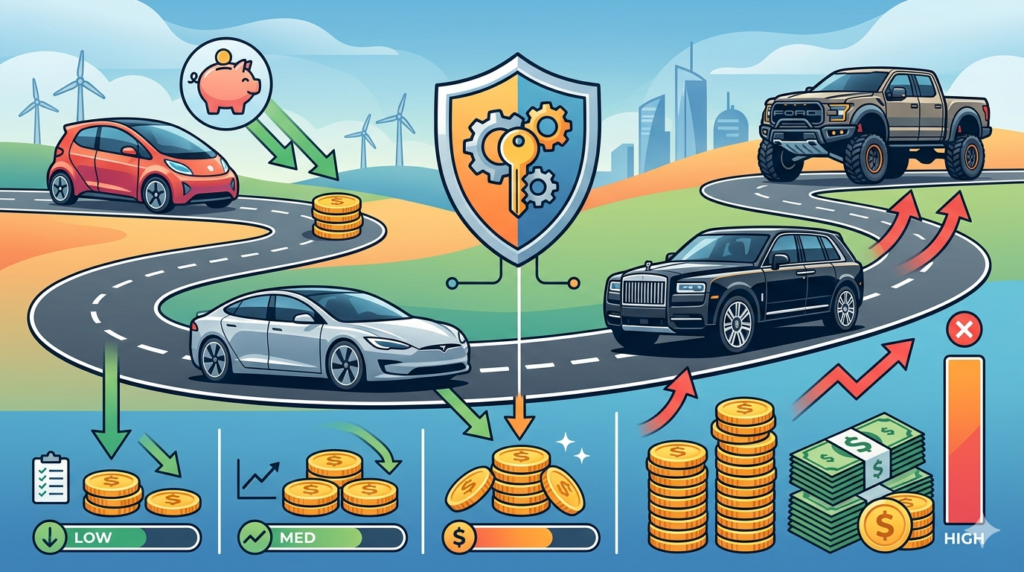
The Five Factors Insurers Look at in Your Vehicle
Every car has a unique insurance profile. Insurers look at five main factors when determining how much to charge for a particular vehicle. Understanding these factors will help you make a smarter choice.
The first factor is the car’s safety rating. Cars with high safety ratings have lower insurance costs because they are less likely to cause severe injuries in an accident. The Insurance Institute for Highway Safety and the National Highway Traffic Safety Administration both publish safety ratings. Cars that earn Top Safety Pick or five star ratings typically cost less to insure.
The second factor is the car’s theft rate. Some cars are stolen much more often than others. Sports cars, luxury SUVs, and certain Honda and Toyota models are popular targets for thieves. If your car is on the frequently stolen list, your comprehensive coverage will be more expensive.
The third factor is the cost of repairs. Luxury cars, electric vehicles, and European imports often have very expensive parts and require specialized repair facilities. If you damage a BMW, a Mercedes, or a Tesla, the repair bill will be much higher than for a Honda Civic or Toyota Camry. Insurers know this, so they charge higher collision and comprehensive premiums for expensive to repair vehicles.
The fourth factor is the car’s performance. Sports cars and high performance sedans are statistically involved in more accidents and more severe accidents than economy cars. A driver in a Ford Mustang is more likely to speed, more likely to take risks, and more likely to crash than the same driver in a Honda Accord. Insurers charge more for performance vehicles.
The fifth factor is the car’s safety features. Modern safety features like automatic emergency braking, lane departure warning, blind spot monitoring, and adaptive headlights can prevent accidents or reduce their severity. Cars with these features often qualify for discounts.
Here is a table summarizing the five factors.
| Factor | What Insurers Look For | Effect on Premium |
|---|---|---|
| Safety ratings | High IIHS and NHTSA ratings | Lowers premium |
| Theft rate | How often the model is stolen | Higher theft = higher premium |
| Repair costs | Cost of parts and labor | Higher cost = higher premium |
| Performance | Horsepower, speed, handling | Higher performance = higher premium |
| Safety features | Automatic braking, blind spot monitoring, etc. | More features = lower premium |
How Safety Ratings Affect Your Insurance Costs
Safety ratings are one of the most important factors in determining your insurance premium. A car that protects its occupants well in a crash will have lower medical payments and lower liability costs for the insurer. Insurers pass these savings on to you in the form of lower premiums.
The Insurance Institute for Highway Safety (IIHS) rates cars as Good, Acceptable, Marginal, or Poor in several crash tests. Cars that earn Good ratings in all tests and have good front crash prevention systems earn the Top Safety Pick designation. Cars that earn Good ratings in all tests plus Good or Acceptable in the passenger side small overlap test earn the Top Safety Pick Plus designation, the highest honor.
The National Highway Traffic Safety Administration (NHTSA) rates cars from one to five stars in frontal crash, side crash, and rollover tests. A five star overall rating is the best possible.
Here is a table showing how safety ratings affect insurance premiums for otherwise identical cars.
| Safety Rating | Typical Premium Impact | Annual Premium on $1,500 Baseline |
|---|---|---|
| IIHS Top Safety Pick Plus | -10% to -15% | $1,275 – $1,350 |
| IIHS Top Safety Pick | -5% to -10% | $1,350 – $1,425 |
| IIHS Good (but not Top Pick) | 0% | $1,500 |
| NHTSA 5 stars | -5% to -10% | $1,350 – $1,425 |
| NHTSA 4 stars | 0% | $1,500 |
| NHTSA 3 stars or below | +10% to +20% | $1,650 – $1,800 |
The difference between a Top Safety Pick Plus vehicle and a three star vehicle can be three hundred dollars or more per year. Over five years of ownership, that is one thousand five hundred dollars.
When you are comparing cars, check their safety ratings on the IIHS and NHTSA websites. Choose a car with the highest possible ratings. It could save you money and might save your life.
How Theft Rates Affect Your Insurance Costs
If your car is stolen, your insurer pays to replace it. Insurers track theft rates closely. Cars that are stolen frequently cost more to insure because the insurer expects to pay more theft claims.
The National Insurance Crime Bureau publishes an annual list of the most stolen vehicles. The list changes over time, but certain models appear consistently. Older Honda Civics and Accords are frequently stolen because their parts are valuable. Full size pickup trucks are also popular targets. Luxury SUVs are stolen for export.
Here is a table showing typical theft rates and their effect on insurance premiums.
| Theft Risk Category | Typical Models | Comprehensive Premium Impact |
|---|---|---|
| Very high | Older Honda Civic, Honda Accord, Ford F-250 | +20% to +40% |
| High | Chevrolet Silverado, Ford F-150, Toyota Camry | +10% to +20% |
| Average | Most midsize sedans and SUVs | 0% |
| Low | Volvo, Tesla (with tracking), luxury cars with GPS | -5% to -15% |
If you are considering a car that is known to be frequently stolen, check the comprehensive premium before you buy. The difference could be hundreds of dollars per year. You can also reduce your risk by installing an anti-theft device like a steering wheel lock, an alarm, or a GPS tracker. Some insurers offer discounts for these devices.
Here is a list of the most stolen vehicles in recent years.
| Rank | Vehicle | Why It Is Stolen |
|---|---|---|
| 1 | Ford F-150 (full size pickup) | Parts demand, easy to sell |
| 2 | Chevrolet Silverado (full size pickup) | Parts demand, easy to sell |
| 3 | Honda Civic (older models) | Parts demand |
| 4 | Honda Accord (older models) | Parts demand |
| 5 | Toyota Camry | Parts demand |
| 6 | Nissan Altima | Parts demand |
| 7 | GMC Sierra (full size pickup) | Parts demand |
| 8 | Toyota Corolla | Parts demand |
| 9 | Dodge Ram (full size pickup) | Parts demand |
| 10 | Ford Fusion | Parts demand |
If you are buying a used car, check its theft history. A car that is ten years old and appears on this list may have higher comprehensive insurance costs than a newer car with better anti-theft technology.
How Repair Costs Affect Your Insurance Costs
The cost to repair your car after an accident is one of the biggest factors in your insurance premium. Insurers know exactly how much it costs to repair every make and model. Cars with expensive parts or complex repair procedures cost more to insure.
Luxury cars are the most expensive to repair. A replacement headlight for a BMW or Mercedes can cost one thousand to two thousand dollars. The same part for a Honda or Toyota costs two hundred to four hundred dollars. Bumpers, fenders, and doors follow the same pattern. The more expensive the parts, the higher your collision and comprehensive premiums.
Electric vehicles are also expensive to repair. Teslas have aluminum bodies that require specialized repair facilities. Replacement batteries can cost ten thousand dollars or more. Some insurers charge significantly higher premiums for electric vehicles because of these repair costs.
Here is a table comparing repair costs for different vehicle categories.
| Vehicle Category | Typical Repair Cost (Front Bumper Replacement) | Annual Collision Premium | Compared to Midsize Sedan |
|---|---|---|---|
| Midsize sedan (Honda Accord) | $800 – $1,200 | $400 | Baseline |
| Compact car (Honda Civic) | $700 – $1,100 | $380 | -5% |
| Small SUV (Honda CR-V) | $900 – $1,400 | $450 | +12% |
| Full size pickup (Ford F-150) | $1,000 – $1,600 | $500 | +25% |
| Entry luxury (BMW 3 Series) | $1,500 – $2,500 | $700 | +75% |
| Electric vehicle (Tesla Model 3) | $1,500 – $3,000 | $800 | +100% |
| Luxury SUV (BMW X5) | $2,000 – $4,000 | $1,000 | +150% |
The difference between a Honda Accord and a BMW X5 can be six hundred dollars per year just for collision coverage. That does not include the higher comprehensive and liability costs that often accompany luxury vehicles.
Before you buy a car, consider not just the purchase price but also the long term cost of ownership. A luxury car that costs ten thousand dollars more to buy may also cost five thousand dollars more to insure over five years. The true cost of the car is much higher than the sticker price.
How Performance Affects Your Insurance Costs
Insurance companies know that drivers of high performance vehicles have more accidents. The statistics are clear. Sports cars, muscle cars, and other high performance vehicles are involved in more accidents and more severe accidents than average cars. Insurers charge higher premiums to reflect this risk.
Here is a table comparing insurance costs for different performance levels.
| Performance Level | Example Models | Horsepower | Typical Annual Premium | Compared to Midsize Sedan |
|---|---|---|---|---|
| Economy | Toyota Corolla, Honda Fit | 100-140 | $1,400 | -7% |
| Standard | Honda Accord, Toyota Camry | 150-200 | $1,500 | Baseline |
| Mid-performance | Honda Civic Si, V6 Camry | 200-300 | $1,800 | +20% |
| High performance | Ford Mustang GT, Subaru WRX | 300-450 | $2,200 | +47% |
| Sports car | Chevrolet Corvette, Porsche 911 | 450-600 | $2,800+ | +87% |
| Exotic | Ferrari, Lamborghini | 600+ | $5,000+ | +233% |
The difference between a standard midsize sedan and a high performance sports car can be one thousand three hundred dollars per year or more. That is money you could spend on fuel, maintenance, or anything else.
If you are a young driver, the performance penalty is even larger. A teenager driving a Ford Mustang will pay dramatically more than the same teenager driving a Honda Civic. The combination of young age and high performance is the most expensive insurance category.
Here is a table showing how performance affects premiums for an eighteen year old driver.
| Vehicle | Horsepower | Annual Premium for 18 Year Old | Difference from Civic |
|---|---|---|---|
| Honda Civic (base) | 158 | $3,000 | Baseline |
| Honda Civic Si | 205 | $3,900 | +$900 |
| Ford Mustang EcoBoost | 310 | $4,500 | +$1,500 |
| Ford Mustang GT | 450 | $5,500 | +$2,500 |
| Subaru WRX | 271 | $4,800 | +$1,800 |
If you are a young driver, choose a car with modest performance. Your insurance rates will be much lower, and you will still have a reliable, enjoyable car.
How Safety Features Affect Your Insurance Costs
Modern safety features can prevent accidents or reduce their severity. Cars with advanced safety features often qualify for insurance discounts. The most valuable features are automatic emergency braking, forward collision warning, lane departure warning, blind spot monitoring, and adaptive headlights.
Here is a table showing common safety features and their typical insurance discounts.
| Safety Feature | What It Does | Typical Discount | Best For |
|---|---|---|---|
| Automatic emergency braking | Brakes automatically to avoid collision | 10-15% | All drivers |
| Forward collision warning | Alerts driver to imminent crash | 5-10% | All drivers |
| Lane departure warning | Alerts driver when drifting from lane | 5-10% | Highway drivers |
| Blind spot monitoring | Alerts driver to cars in blind spot | 5-10% | City and highway drivers |
| Adaptive headlights | Headlights turn with steering wheel | 5-10% | Night drivers |
| Rearview camera | Shows what is behind car | 0-5% | All drivers (standard since 2018) |
| Parking sensors | Alerts to obstacles when parking | 0-5% | City drivers |
If your car has these features, tell your insurer. The online quote form may not ask about them. You may need to call and speak to an agent. Have your car’s window sticker or a list of features ready.
Some insurers offer a discount for vehicles with advanced safety features regardless of your driving record. Others only apply the discount if you have a clean record. Ask your agent how your insurer handles safety feature discounts.
The Cheapest Cars to Insure
Now that you understand the factors that affect insurance costs, here are the cars that are consistently cheapest to insure. These vehicles have high safety ratings, low theft rates, affordable repair costs, modest performance, and good safety features.
Here is a table of the cheapest cars to insure for most drivers.
| Rank | Vehicle | Why It Is Cheap to Insure | Typical Annual Premium |
|---|---|---|---|
| 1 | Honda Civic | High safety, low theft, cheap parts, good features | $1,400 – $1,600 |
| 2 | Honda Accord | High safety, low theft, cheap parts, good features | $1,400 – $1,600 |
| 3 | Toyota Camry | High safety, low theft, cheap parts, good features | $1,400 – $1,600 |
| 4 | Toyota Corolla | High safety, low theft, cheap parts, good features | $1,350 – $1,550 |
| 5 | Subaru Outback | High safety, all-wheel drive, family oriented | $1,450 – $1,650 |
| 6 | Subaru Forester | High safety, all-wheel drive, family oriented | $1,450 – $1,650 |
| 7 | Mazda CX-5 | High safety, good crash test results | $1,500 – $1,700 |
| 8 | Ford Escape | Common vehicle, cheap parts, family oriented | $1,500 – $1,700 |
| 9 | Hyundai Elantra | High safety, good features, affordable | $1,400 – $1,600 |
| 10 | Kia Forte | High safety, good features, affordable | $1,400 – $1,600 |
These cars are not the most exciting, but they are smart choices for drivers who want to keep their insurance costs low. They are reliable, safe, and affordable to own and insure.
If you are a young driver, a parent of a young driver, or simply someone who wants to save money, start your car search with this list.
The Most Expensive Cars to Insure
Here are the cars that are consistently most expensive to insure. These vehicles have low safety ratings, high theft rates, expensive repair costs, high performance, or a combination of these factors.
Here is a table of the most expensive cars to insure for most drivers.
| Rank | Vehicle | Why It Is Expensive to Insure | Typical Annual Premium |
|---|---|---|---|
| 1 | Tesla Model S | Extremely expensive to repair, high performance | $3,500 – $5,000 |
| 2 | Tesla Model 3 | Expensive to repair, parts availability issues | $2,500 – $3,500 |
| 3 | BMW 7 Series | Expensive parts, luxury status, high performance | $3,000 – $4,000 |
| 4 | Mercedes S-Class | Expensive parts, luxury status, high performance | $3,000 – $4,000 |
| 5 | Ford Mustang GT | High performance, higher accident rates | $2,200 – $3,000 |
| 6 | Chevrolet Camaro SS | High performance, higher accident rates | $2,200 – $3,000 |
| 7 | Dodge Charger (high trim) | High performance, theft risk | $2,200 – $3,000 |
| 8 | BMW 3 Series | Expensive parts, luxury status | $2,000 – $2,800 |
| 9 | Mercedes C-Class | Expensive parts, luxury status | $2,000 – $2,800 |
| 10 | Audi A4 | Expensive parts, luxury status | $2,000 – $2,800 |
If you are considering one of these cars, get insurance quotes before you buy. You may be surprised by how much the insurance adds to your monthly payment. A Tesla Model 3 that costs six hundred dollars per month to finance might cost two hundred fifty dollars per month to insure. That is a significant addition to your budget.
How to Compare Insurance Costs Before You Buy
The best way to avoid an insurance surprise is to compare insurance costs before you buy a car. You can do this in a few minutes using online tools.
Here is a step by step process.
First, identify two or three cars you are considering. Write down the make, model, year, and trim level. The trim level matters. A Honda Civic LX (base) costs less to insure than a Honda Civic Si (performance). Make sure you are comparing the specific trim you want.
Second, get insurance quotes for each car using the same coverage limits. Use a comparison site like The Zebra or Insurify. Enter your personal information and the car details. Use the same coverage limits for every quote.
Third, compare the results. The difference between the cheapest and most expensive car to insure might be hundreds of dollars per year. That difference could influence your decision.
Here is a table showing how to compare insurance costs for different cars.
| Car | Trim | Annual Insurance Quote | Difference from Cheapest |
|---|---|---|---|
| Honda Civic | LX | $1,450 | Baseline |
| Honda Civic | Si | $1,900 | +$450 |
| Toyota Camry | LE | $1,480 | +$30 |
| Ford Mustang | EcoBoost | $2,100 | +$650 |
| Tesla Model 3 | Standard | $2,800 | +$1,350 |
If you are buying a used car, you can also call your current insurer and ask for a quote on a specific VIN. Use the VIN of a car you are considering at a dealership. The agent can give you an accurate quote for that exact vehicle.
Real Example: How Vehicle Choice Saved One Driver $800 Per Year
Let us walk through a real example to see how vehicle choice affects insurance costs. Meet Michael, a twenty five year old driver with a clean record. He is shopping for a new car. He has narrowed his choices to two vehicles: a 2024 Honda Civic LX and a 2024 Ford Mustang EcoBoost. Both are about the same price, around twenty eight thousand dollars.
Michael gets insurance quotes for both cars using the same coverage limits. He has liability at one hundred thousand dollars per person and three hundred thousand dollars per accident, comprehensive and collision with five hundred dollar deductibles, uninsured motorist coverage, and medical payments.
Here are the quotes.
| Car | Annual Insurance Premium |
|---|---|
| Honda Civic LX | $1,450 |
| Ford Mustang EcoBoost | $2,250 |
The Mustang costs eight hundred dollars more per year to insure. Over five years of ownership, that is four thousand dollars. The Mustang also gets worse fuel economy and has higher maintenance costs. The true cost of owning the Mustang is much higher than the sticker price.
Michael chooses the Honda Civic. He saves eight hundred dollars per year on insurance, plus additional savings on fuel and maintenance. He still has a reliable, safe, enjoyable car. He simply made a smarter choice.
The Bottom Line on How Vehicle Choice Affects Insurance Costs
The car you choose has a massive impact on your insurance costs. Safety ratings, theft rates, repair costs, performance, and safety features all affect your premium. A car with high safety ratings, low theft rates, affordable parts, modest performance, and good safety features will cost much less to insure than a car with poor safety ratings, high theft rates, expensive parts, and high performance.
Before you buy any car, get insurance quotes for the specific models you are considering. The difference in insurance costs might be hundreds or even thousands of dollars per year. That difference could influence your decision.
If you want to keep your insurance costs low, choose a car with the following characteristics. Four doors instead of two. A four cylinder engine instead of six or eight cylinders. High safety ratings from IIHS and NHTSA. Low theft rates. Affordable repair costs. Advanced safety features like automatic emergency braking. Modest performance.
The cheapest cars to insure are typically midsize sedans, compact cars, and small SUVs from mainstream brands like Honda, Toyota, Subaru, Mazda, Hyundai, and Kia. The most expensive cars to insure are typically luxury vehicles, sports cars, electric vehicles, and high performance models.
Your vehicle choice is one of the few factors in your insurance premium that you have complete control over. You cannot change your age. You cannot change your driving record overnight. But you can choose a car that is cheap to insure. That choice will save you money every year you own the car.