Comparing car insurance quotes seems simple in theory. You go to a few websites, enter some information, and pick the lowest price. What could go wrong? As it turns out, quite a lot. The process of comparing car insurance quotes is filled with traps, hidden details, and subtle differences that can cost you hundreds of dollars or leave you dangerously underinsured. Even smart, careful drivers make mistakes because they do not know what to look for.
The good news is that every mistake is avoidable once you know it exists. This article will walk you through the most common mistakes drivers make when comparing car insurance quotes. You will learn exactly what to watch for, how to spot a bad deal disguised as a good one, and how to ensure that the quote you compare is the quote you actually get. By the end, you will be able to compare quotes with confidence and avoid the pitfalls that catch most drivers.
Why Small Mistakes Lead to Big Problems
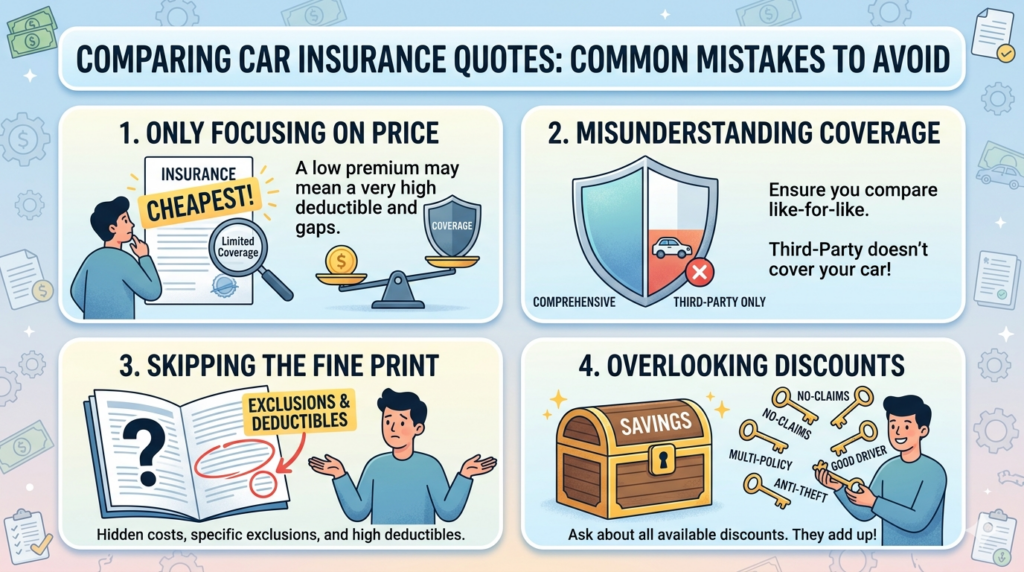
Before we dive into the specific mistakes, it helps to understand why seemingly small errors in comparing car insurance quotes can have such large consequences. Car insurance is a product where the details matter enormously. Two policies that look identical on the surface can have dramatically different coverage levels, and two quotes that are only a few dollars apart can represent vastly different value.
The problem is that insurance companies know most drivers do not read the fine print. They know you are looking at the monthly price and not much else. So they design their quotes to look attractive at first glance while hiding the compromises in the details. A policy with a low monthly payment might have a very high deductible, or it might exclude coverage that you assume is included.
The mistakes listed in this article are not rare edge cases. They happen every day to thousands of drivers. But once you know what they are, you can avoid them easily. The key is slowing down, reading carefully, and always comparing the same coverage across every quote.
Mistake One: Comparing Different Coverage Limits
This is by far the most common mistake drivers make when comparing car insurance quotes. You get a quote from Insurer A for one hundred twenty dollars per month and a quote from Insurer B for one hundred fifty dollars per month. You choose Insurer A because it is cheaper. But you did not notice that Insurer A’s quote includes state minimum liability limits of twenty five thousand dollars per person, while Insurer B’s quote includes one hundred thousand dollars per person.
The difference in protection is enormous. If you cause an accident that sends someone to the hospital, twenty five thousand dollars will not even cover a single night in the intensive care unit. You would be personally responsible for the remaining tens of thousands of dollars. Insurer B’s higher monthly payment would have protected you completely. By focusing only on the price, you made a dangerous choice.
Here is a table showing how different liability limits affect your financial exposure in a serious accident.
| Liability Limit | Monthly Premium (Estimate) | Out of Pocket Cost After a $100,000 Accident |
|---|---|---|
| $25,000 per person (state minimum) | $95 | $75,000 |
| $50,000 per person | $110 | $50,000 |
| $100,000 per person | $130 | $0 |
| $250,000 per person | $160 | $0 |
As the table shows, paying an extra thirty five dollars per month to go from state minimum to one hundred thousand dollars in coverage saves you from a potential seventy five thousand dollar out of pocket expense. That is one of the best bargains in all of personal finance, but you only see it if you compare the coverage limits, not just the prices.
The fix for this mistake is simple. Before you request any quotes, decide on your desired coverage limits. Write them down. Use exactly those limits when you fill out every quote form. Then compare only the prices for identical coverage. If a quote has lower limits, discard it or ask for a new quote with your limits.
Mistake Two: Ignoring the Deductible
The deductible is the amount you pay out of pocket before your insurance kicks in after an accident. A policy with a five hundred dollar deductible is more expensive per month than a policy with a one thousand dollar deductible, but it costs you five hundred dollars less out of pocket if you have an accident. When you compare car insurance quotes, you must compare deductibles as carefully as you compare liability limits.
The trap is that many online quote forms default to a high deductible to make the monthly price look lower. You see one hundred dollars per month, but you do not notice that the deductible is two thousand five hundred dollars. Six months later, you have a minor fender bender, and you discover that you have to pay two thousand five hundred dollars before your insurance pays anything. That one hundred dollar per month policy just became very expensive.
Here is a table showing the trade off between monthly premium and deductible for a typical driver with a clean record.
| Deductible | Monthly Premium | Annual Premium | Out of Pocket After Accident |
|---|---|---|---|
| $250 | $115 | $1,380 | $250 |
| $500 | $100 | $1,200 | $500 |
| $1,000 | $85 | $1,020 | $1,000 |
| $2,500 | $70 | $840 | $2,500 |
The right choice depends on your savings. If you have one thousand dollars in an emergency fund, choosing the one thousand dollar deductible saves you one hundred eighty dollars per year in premiums compared to the five hundred dollar deductible. If you do not have one thousand dollars saved, the five hundred dollar deductible is safer even though it costs more each month.
The fix is to always compare quotes with the same deductible. Choose the deductible that matches your savings, then request that deductible from every insurer. If an insurer gives you a quote with a different deductible, ask them to recalculate using your preferred number.
Mistake Three: Forgetting to Add Uninsured Motorist Coverage
Uninsured motorist coverage protects you if you are hit by a driver who has no insurance or not enough insurance to cover your medical bills and car repairs. Despite the fact that nearly one in eight drivers on American roads has no insurance, many online quotes exclude uninsured motorist coverage by default to make the price look lower.
This is a dangerous omission. If you are hit by an uninsured driver and you do not have uninsured motorist coverage, you have few options. You can sue the driver, but if they have no insurance, they likely have no assets to collect. You can use your own health insurance for medical bills, but you will still owe your health insurance deductibles and copays. You will also have to pay for your car repairs out of pocket.
The cost of adding uninsured motorist coverage is surprisingly low. For most drivers, it adds five to fifteen dollars per month. That small amount buys you protection against one of the biggest risks on the road. When you compare car insurance quotes, always check whether uninsured motorist coverage is included. If it is not, add it to every quote before comparing.
The fix is to make uninsured motorist coverage a non negotiable part of your policy. Decide on your desired limits, typically matching your liability limits, and include them in every quote request. If a quote does not include this coverage, ask for a new quote that does.
Mistake Four: Not Disclosing All Drivers in Your Household
When you request a car insurance quote, the form asks about all licensed drivers in your household. Many drivers make the mistake of listing only themselves, especially if they have a teenager or a young adult living at home. They assume that because the teenager has their own car or rarely drives, they do not need to be listed.
This is a serious mistake. Insurance companies assume that any licensed driver in your household has access to your vehicles. If that driver has an accident in your car and you did not disclose them on your application, the insurer can deny the claim entirely. You could be left paying for the accident out of pocket, and the insurer may also cancel your policy for material misrepresentation.
The fix is to be completely honest about all household members who have a driver’s license. If you have a teenager who does not drive your car, ask the insurer about a named driver exclusion. This is a form that explicitly states that a specific person is excluded from coverage. With a signed exclusion, you do not have to pay for that driver on your policy, but you also cannot let them drive your car for any reason.
Here is a table showing how adding a teenage driver affects annual premiums, and how a named driver exclusion can help.
| Household Situation | Annual Premium | Risk |
|---|---|---|
| No teenage drivers | $1,200 | Low |
| Teenager listed on policy | $2,400 | Covered if they drive |
| Teenager not listed (dishonest) | $1,200 | Claim denial risk |
| Teenager with named driver exclusion | $1,200 | No coverage for teen, but honest |
The only safe options are the first and fourth rows. Either list the teenager and pay the higher premium, or sign a named driver exclusion and ensure they never drive your car. Never hide a household driver to save money.
Mistake Five: Using Estimated Mileage Instead of Actual Mileage
Your annual mileage is one of the key factors in determining your car insurance quotes. Drivers who drive more miles are on the road more often, so they have more opportunities to have an accident. Insurers charge higher premiums for higher mileage.
The mistake many drivers make is underestimating their mileage to get a lower quote. They think a few thousand miles here or there does not matter. But insurers have ways of verifying mileage. Some use telematics devices that track your actual driving. Others check your odometer readings at inspection or when you file a claim. If you claim you drive eight thousand miles per year but your odometer shows twelve thousand, your claim can be reduced or denied.
The fix is to be honest about your mileage. If you are not sure how many miles you drive, there is an easy way to calculate it. Look at your odometer on January first and write down the number. Look at it again on December thirty first and subtract. That is your annual mileage. If you want a more current estimate, track your mileage for one typical week, multiply by fifty two, and add a buffer for road trips and errands.
If you are a low mileage driver, make sure your quote reflects that. Many insurers offer low mileage discounts for drivers who drive less than seven thousand five hundred or ten thousand miles per year. Being honest about your low mileage can actually lower your premium.
Mistake Six: Ignoring the Difference Between Comprehensive and Collision
Comprehensive and collision coverage are often grouped together, but they cover very different things. Collision coverage pays for damage to your car from crashing into another car or an object like a tree or a guardrail. Comprehensive coverage pays for damage from theft, vandalism, weather, fire, and animal strikes.
The mistake drivers make is assuming that having one means having the other, or not understanding when each applies. If your car is stolen and you only have collision coverage, you receive nothing. If you hit a deer and you only have comprehensive coverage, you receive nothing. Both are needed for complete protection.
Here is a table explaining what each coverage pays for and when you need it.
| Type of Damage | Covered by Collision? | Covered by Comprehensive? |
|---|---|---|
| Hitting another car | Yes | No |
| Hitting a tree or pole | Yes | No |
| Hitting a deer or other animal | No | Yes |
| Theft of the vehicle | No | Yes |
| Vandalism | No | Yes |
| Hail or falling tree branch | No | Yes |
| Broken windshield | No | Yes (often with no deductible) |
The fix is to decide whether you need both coverages based on the value of your car. If your car is worth more than three thousand to five thousand dollars, you should carry both. If your car is older and worth less than that, you might consider dropping both or keeping only one depending on your specific risks. When you compare car insurance quotes, always check whether the quote includes both comprehensive and collision, or only one of them.
Mistake Seven: Not Asking About Discounts
This mistake is not about comparing incorrectly. It is about leaving money on the table. Most drivers assume that the quote they see online includes every discount they qualify for. That assumption is usually wrong. Insurers do not automatically apply every discount. Some discounts require you to ask. Others require you to provide additional information.
The most commonly missed discounts include the defensive driving discount, which can save five to fifteen percent for completing an approved online course. The good student discount saves up to twenty five percent for drivers under twenty five with a B average or higher. The low mileage discount saves five to fifteen percent for drivers under seven thousand five hundred miles per year. The bundling discount saves ten to twenty five percent for combining car insurance with renters or homeowners insurance. The pay in full discount saves five to fifteen percent for paying your annual premium upfront. The affiliation discount saves five to fifteen percent for being a member of certain professional organizations, alumni associations, or even specific employers.
The fix is simple. When you get a quote, ask the agent or customer service representative one question. Are there any other discounts I might qualify for? Then listen. The agent will walk you through a list of possible discounts. Answer each question honestly. You may discover that you qualify for two or three discounts you did not know existed.
Mistake Eight: Assuming the Online Quote Is Final
Online car insurance quotes are estimates, not binding contracts. The price you see on your screen can change after the insurer runs your credit report, pulls your motor vehicle record, and checks your claims history through the CLUE report. This is not a bait and switch. It is simply that the online form does not have access to your full history.
The mistake is assuming that the online quote is the price you will pay. Many drivers receive a quote for one hundred dollars per month, complete the application, and then are surprised when the final price is one hundred thirty dollars per month. They feel tricked, but they were not tricked. They just did not understand that the initial quote was conditional.
The fix is to always request a binding quote before you purchase. A binding quote is one that cannot change after the insurer has completed all underwriting checks. To get a binding quote, you need to provide your driver’s license number and authorize a credit check. This takes a few extra minutes, but it gives you certainty.
Here is a table showing the difference between an estimated online quote and a binding quote.
| Quote Type | Information Used | Can Price Change? | Time to Get |
|---|---|---|---|
| Estimated online quote | Self reported data only | Yes, often 10-30% higher | 2 minutes |
| Binding quote | Driver’s license, MVR, credit check, CLUE report | No | 10 minutes |
The extra eight minutes to get a binding quote is time well spent. It protects you from surprises and ensures that the price you compare is the price you actually pay.
Mistake Nine: Comparing Monthly Payments Instead of Annual Premiums
This mistake seems small, but it can cost you real money. When you look at a quote, you see a monthly payment. That monthly payment might include installment fees, processing fees, or interest charges that are not part of the actual insurance premium. Two policies with the same annual premium can have different monthly payments because one charges fees and the other does not.
For example, Insurer A offers an annual premium of one thousand two hundred dollars with no monthly fees. Your monthly payment is one hundred dollars. Insurer B offers an annual premium of one thousand two hundred dollars with a five dollar per month installment fee. Your monthly payment is one hundred five dollars. If you compare only the monthly payments, you think Insurer B is more expensive. But if you pay the annual premium upfront with Insurer B, you avoid the fees entirely and pay the same as Insurer A.
The fix is to always ask for the total annual premium assuming payment in full. That is the true cost of the policy. Then, if you prefer to pay monthly, ask what the monthly fees are and calculate the total annual cost including fees. Compare that number, not just the monthly payment.
Mistake Ten: Not Comparing Customer Service and Claims Satisfaction
Price is important, but it is not the only factor. A cheap policy from an insurer with terrible customer service can become very expensive when you need to file a claim and you are stuck on hold for hours or your claim is denied for a technicality. Comparing car insurance quotes means comparing the whole package, not just the price.
Every state insurance department publishes complaint ratios for insurers licensed in that state. A complaint ratio of 1.0 means the insurer receives an average number of complaints relative to their market share. A ratio above 1.0 means more complaints than average. A ratio below 1.0 means fewer complaints.
The fix is to check complaint ratios for your top two or three quotes before making a decision. Do not buy a policy from an insurer with a complaint ratio above 1.5 just to save twenty dollars per month. The frustration and risk are not worth it.
Here is a table showing sample complaint ratios for major insurers. Actual ratios vary by state.
| Insurance Company | Complaint Ratio (Lower is Better) | Customer Service Rating |
|---|---|---|
| USAA | 0.5 | Excellent |
| Geico | 0.7 | Very Good |
| State Farm | 0.8 | Very Good |
| Progressive | 0.9 | Good |
| Travelers | 1.0 | Good |
| National average | 1.0 | Average |
Real Example: How One Driver Avoided Costly Mistakes
Let us walk through a real example of a driver who almost made several of these mistakes but caught them in time. Sarah is a thirty one year old driver in Florida with a clean record. She drives a 2021 Nissan Rogue about fifteen thousand miles per year. She starts comparing car insurance quotes online.
Her first quote from Insurer A shows one hundred ten dollars per month. It looks great. But Sarah remembers to check the coverage limits. The quote has liability limits of only ten thousand dollars per person, which is the Florida state minimum. She discards it and requests a new quote with her desired limits of one hundred thousand dollars per person.
Her second quote from Insurer B shows one hundred forty dollars per month with the correct liability limits. The deductible is five hundred dollars, which matches her savings. But Sarah notices that the quote does not include uninsured motorist coverage. Florida has one of the highest rates of uninsured drivers in the country, nearly twenty six percent. She adds uninsured motorist coverage for an extra twelve dollars per month.
Her third quote from Insurer C shows one hundred thirty five dollars per month. It has the right liability limits, the right deductible, and includes uninsured motorist coverage. But Sarah calls the company to ask about discounts. The agent mentions a defensive driving discount. Sarah takes an online course for thirty dollars, and her premium drops to one hundred twenty five dollars per month.
Sarah also checks the complaint ratio for Insurer C on the Florida Office of Insurance Regulation website. The ratio is 0.8, below the state average of 1.0. She is comfortable with that.
By avoiding the common mistakes, Sarah ends up with a policy that has strong coverage, a fair price, and a reputable insurer. She almost overpaid for dangerously low coverage, but she caught the errors because she knew what to look for.
The Bottom Line on Common Mistakes When Comparing Car Insurance Quotes
Comparing car insurance quotes is not difficult, but it requires attention to detail. The most common mistakes are comparing different coverage limits, ignoring deductibles, forgetting uninsured motorist coverage, hiding household drivers, underestimating mileage, confusing comprehensive and collision, not asking about discounts, assuming online quotes are final, comparing monthly payments instead of annual premiums, and ignoring customer service ratings.
Each of these mistakes can cost you money or leave you dangerously underinsured. But every one of them is avoidable. By slowing down, reading carefully, and using the same coverage limits across every quote, you can compare with confidence and choose the policy that offers the best combination of price, protection, and reliability.
The time you spend avoiding these mistakes is an investment in your financial security. A few extra minutes of careful comparison today can save you hundreds of dollars and prevent a devastating coverage gap tomorrow. Do not rush. Do not assume. And never buy a policy based on the monthly price alone. Your future self will thank you.