Car insurance is one of those expenses that every driver hates but no one can avoid. You pay your premium every month, and if you never have an accident, it feels like you are throwing money away. But the moment you need it, you are grateful it is there. The challenge is finding the balance between paying too much for coverage you do not need and paying too little for protection that leaves you exposed.
The good news is that there are legitimate, proven ways to reduce your car insurance costs without sacrificing the coverage that matters. These are not tricks or loopholes. They are smart financial strategies that align with how insurance companies actually calculate risk. Some strategies save you money immediately. Others take a bit of time but pay off for years. All of them work.
This article will show you the best ways to reduce your car insurance costs. You will learn immediate actions you can take today, short term strategies for the next few months, and long term habits that will keep your rates low for years. By the end, you will have a complete playbook for paying less without losing protection.
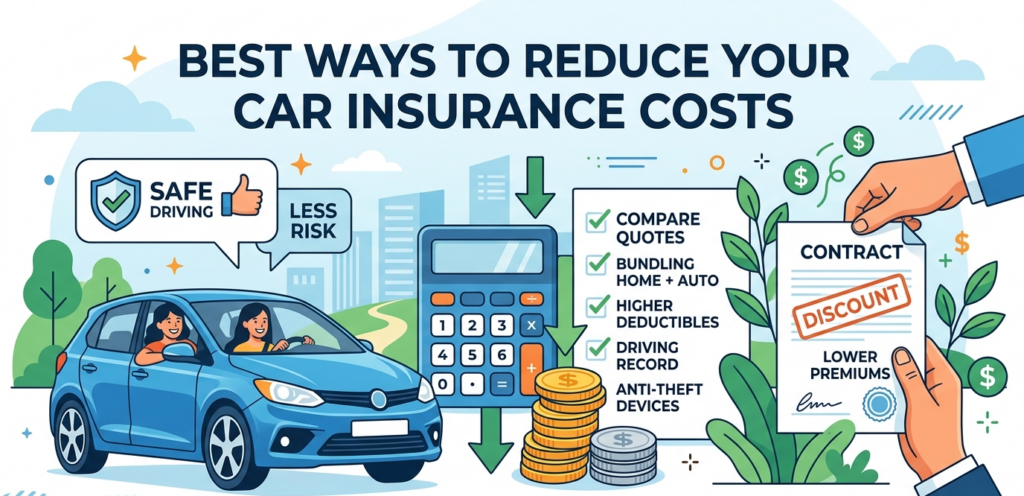
Immediate Actions You Can Take Today
Some of the best ways to reduce your car insurance costs require no waiting. You can take these actions today and see savings on your next bill. Do not put them off. Every day you wait is money out of your pocket.
The first immediate action is to raise your deductibles. Your deductible is the amount you pay out of pocket before insurance kicks in after an accident. A higher deductible means you are taking on more risk, so the insurer charges you less. Raising your collision deductible from five hundred dollars to one thousand dollars typically saves fifteen to thirty percent on that portion of your premium.
Here is a table showing how much you can save by raising your deductibles today.
| Current Deductible | New Deductible | Typical Savings | Annual Savings on $1,500 Premium |
|---|---|---|---|
| $250 | $500 | 10-15% | $150 – $225 |
| $250 | $1,000 | 20-30% | $300 – $450 |
| $500 | $1,000 | 10-15% | $150 – $225 |
| $500 | $2,500 | 25-35% | $375 – $525 |
| $1,000 | $2,500 | 10-15% | $150 – $225 |
The key to making this work is having the savings to cover your higher deductible. Before you raise your deductible, make sure you have that amount in your emergency fund. If you raise your deductible to one thousand dollars but only have five hundred dollars in savings, you are taking a risk you cannot afford.
The second immediate action is to review your annual mileage. Most drivers overestimate how many miles they drive. If you have been reporting twelve thousand miles per year but actually drive nine thousand, you are paying too much. Low mileage discounts typically apply for drivers under seven thousand five hundred or ten thousand miles per year.
Call your insurer today and ask what mileage they have on file. Then calculate your actual annual mileage. Look at your odometer from one year ago and subtract from today’s reading. If the number is lower than what your insurer has, ask them to update it. This one phone call can save you five to fifteen percent immediately.
The third immediate action is to ask about every discount you might qualify for. Many drivers assume their insurer has automatically applied all available discounts. This is almost never true. Some discounts require you to ask. Others require you to provide documentation.
Here is a checklist of discounts to ask about right now.
| Discount | Ask Your Agent |
|---|---|
| Safe driver (no accidents/tickets) | “Do I have the safe driver discount?” |
| Defensive driving course | “Do you offer a discount for completing a course?” |
| Good student | “Does my child’s GPA qualify for a discount?” |
| Low mileage | “What mileage do you have on file for me?” |
| Bundling | “Do I save by bundling with renters/homeowners?” |
| Pay in full | “How much do I save by paying annually?” |
| Automatic payment | “Is there a discount for autopay?” |
| Paperless billing | “Do you offer a discount for paperless?” |
| Anti-theft device | “Does my car’s alarm qualify for a discount?” |
| Occupation | “Does my job qualify for any discount?” |
| Affiliation | “Does my alumni association offer a discount?” |
Go down this list one by one. Ask each question. You will be surprised how many discounts you qualify for that are not currently applied to your policy.
Short Term Strategies for the Next Few Months
Beyond the immediate actions, there are strategies that take a bit more time but can reduce your car insurance costs significantly within the next few months.
The most powerful short term strategy is to shop around for a new policy. Most drivers stay with the same insurer for years, assuming loyalty is rewarded. The opposite is true. Insurers use introductory discounts to attract new customers, then slowly raise rates at each renewal. If you have been with the same insurer for more than two years, you are likely overpaying.
Set aside one hour this week to get quotes from at least five insurers. Use comparison sites like The Zebra or Insurify to get a broad view of the market. Then get direct quotes from Geico, State Farm, Progressive, and Travelers. Use the exact same coverage limits on every quote.
Here is a table showing potential savings from switching insurers.
| Years with Current Insurer | Likely Overpayment | Potential Savings from Switching |
|---|---|---|
| 1 year | 0-5% | $0 – $75 |
| 2 years | 5-15% | $75 – $225 |
| 3 years | 10-20% | $150 – $300 |
| 4 years | 15-25% | $225 – $375 |
| 5+ years | 20-35% | $300 – $525 |
Do not assume your current insurer is giving you the best rate just because you have been a loyal customer. Loyalty is not rewarded in car insurance. Switching every two to three years is one of the best ways to keep your rates low.
Another short term strategy is to complete a defensive driving course. Most insurers offer a discount of five to fifteen percent for drivers who complete an approved course. The course takes about six hours and can be done entirely online for twenty five to fifty dollars. The discount lasts for three years.
The math is simple. If you pay one thousand five hundred dollars per year for insurance, a ten percent discount saves you one hundred fifty dollars annually. Over three years, that is four hundred fifty dollars in savings. Your cost for the course is fifty dollars. Your net savings are four hundred dollars. That is an excellent return on a small investment of time and money.
If you are a student or have a student in your household, the good student discount is another short term strategy. Students under twenty five with a B average or higher can save fifteen to twenty five percent. The discount applies to the student’s portion of the premium if they are on your policy, or to the entire policy in some cases.
Provide your insurer with a report card or transcript. The discount is substantial and requires almost no effort beyond submitting documentation.
Long Term Habits That Keep Rates Low
The best ways to reduce your car insurance costs are not one time actions. They are long term habits that keep your rates low year after year. These habits require discipline, but the payoff is thousands of dollars in savings over time.
The most important long term habit is maintaining a clean driving record. Every year you drive without an accident or ticket improves your safe driver status. After three years, you qualify for the best rates at most insurers. After five years, you qualify for the absolute best rates.
Here is a table showing how your rates improve with each year of clean driving.
| Years Accident and Ticket Free | Risk Category | Typical Premium Compared to Driver with One Accident |
|---|---|---|
| 0 (recent accident) | High risk | +40-60% |
| 1 year | Elevated risk | +20-30% |
| 2 years | Near standard | +10-15% |
| 3 years | Standard safe driver | 0% (baseline) |
| 4 years | Preferred safe driver | -5-10% |
| 5+ years | Super preferred | -10-20% |
Every day you drive safely is an investment in lower future rates. A single speeding ticket can cost you not just the fine, but thousands in increased insurance premiums over three years. Drive like your wallet depends on it, because it does.
Another long term habit is improving your credit score. In most states, your credit based insurance score affects your car insurance premium. Drivers with excellent credit pay significantly less than drivers with poor credit. The difference can be forty to sixty percent.
Here is a table showing how credit score improvements affect your premium over time.
| Credit Score | Typical Premium | Improvement from Previous Level |
|---|---|---|
| 580 (poor) | $2,400 | Baseline |
| 650 (fair) | $2,000 | -17% |
| 700 (good) | $1,700 | -15% |
| 750 (very good) | $1,450 | -15% |
| 800+ (excellent) | $1,250 | -14% |
Improving your credit takes time, but the payoff is substantial. Pay all bills on time. Reduce credit card balances. Do not open new credit accounts unnecessarily. Dispute errors on your credit report. Even small improvements can lead to meaningful savings on your car insurance.
A third long term habit is choosing cars that are cheap to insure. When you buy your next car, factor insurance costs into your decision. Two cars with the same purchase price can have dramatically different insurance premiums. A midsize sedan like a Honda Accord or Toyota Camry is much cheaper to insure than a sports car or luxury SUV.
Before you buy any car, get insurance quotes for the specific model and trim level you are considering. Use the VIN from a car on the dealer lot to get an accurate quote. If the insurance cost is higher than you expected, consider a different trim level or a different model altogether.
Here is a table showing average insurance costs for different vehicle types.
| Vehicle Type | Example Models | Annual Premium | Compared to Midsize Sedan |
|---|---|---|---|
| Midsize sedan | Honda Accord, Toyota Camry | $1,500 | Baseline |
| Small SUV | Honda CR-V, Toyota RAV4 | $1,550 | +3% |
| Minivan | Honda Odyssey, Toyota Sienna | $1,580 | +5% |
| Pickup truck | Ford F-150, Ram 1500 | $1,650 | +10% |
| Entry luxury | BMW 3 Series, Mercedes C-Class | $2,000 | +33% |
| Sports car | Ford Mustang, Chevrolet Camaro | $2,200 | +47% |
| Luxury SUV | BMW X5, Mercedes GLE | $2,300 | +53% |
The difference between a midsize sedan and a luxury SUV can be eight hundred dollars per year or more. Over five years of ownership, that is four thousand dollars. Your car choice is one of the biggest factors in your insurance cost. Choose wisely.
How to Use Telematics to Lower Your Rates
Telematics programs use a smartphone app or a small device plugged into your car to monitor your driving habits. Safe drivers are rewarded with lower rates. If you are a safe driver, telematics is one of the best ways to reduce your car insurance costs.
Here is a table comparing the major telematics programs.
| Program | How It Works | What It Tracks | Typical Savings for Safe Drivers |
|---|---|---|---|
| Progressive Snapshot | Plug-in device or app | Speed, braking, time of day, mileage | $150+ per year |
| State Farm Drive Safe & Save | App or device | Speed, braking, cornering, phone use, mileage | Up to 30% |
| Geico DriveEasy | App only | Speed, braking, phone use, time of day | Up to 25% |
| Allstate Drivewise | App only | Speed, braking, time of day, mileage | Up to 25% |
| Nationwide SmartRide | App or device | Speed, braking, time of day, mileage | Up to 25% |
The key to success with telematics is understanding what the program tracks and how to drive to maximize your discount. Here are the most important factors.
Smooth braking is the most heavily weighted factor in most programs. Hard braking indicates aggressive driving or following too closely. To improve your braking score, increase your following distance. Leave four to five seconds between you and the car in front of you. This gives you more time to brake gradually.
Smooth acceleration is also important. Rapid acceleration from a stoplight is fun, but it signals aggressive driving. Accelerate gradually and smoothly. Your car will thank you, and so will your insurance discount.
Time of day matters because late night driving is riskier. Driving between midnight and 4 AM is heavily penalized in most telematics programs. If you can avoid driving during these hours, do so. If you must drive late at night for work, some programs allow you to explain your situation.
Phone use while driving is tracked by app based programs. If you touch your phone while the car is moving, you will be penalized. Put your phone in the glove compartment or use a do not disturb while driving feature. The savings from avoiding phone use are substantial.
Low mileage is rewarded in most programs. The less you drive, the lower your risk. If you drive less than average, your telematics discount will reflect that.
If you are a safe driver, telematics is not a risk. It is an opportunity to prove what you already know. You drive safely. Now you can get paid for it.
When to Drop Coverage You Do Not Need
One of the best ways to reduce your car insurance costs is to stop paying for coverage you do not need. As your car ages and your financial situation changes, certain coverages become less valuable. Dropping them can save you hundreds of dollars per year.
The most common coverage to drop is collision and comprehensive on an older car. When your car’s value drops below three thousand to five thousand dollars, the annual premium may be too high relative to the potential payout.
Here is a table to help you decide when to drop collision and comprehensive.
| Your Car’s Value | Annual Collision/Comprehensive Premium | Years of Premium to Equal Car Value | Drop Coverage? |
|---|---|---|---|
| $10,000 | $600 | 16.7 years | No |
| $8,000 | $600 | 13.3 years | No |
| $6,000 | $600 | 10 years | Consider |
| $5,000 | $600 | 8.3 years | Consider |
| $4,000 | $600 | 6.7 years | Probably |
| $3,000 | $600 | 5 years | Yes |
| $2,000 | $600 | 3.3 years | Yes |
If you decide to drop collision and comprehensive, you are self insuring. This means you are accepting the risk of paying for repairs or replacement out of your own pocket. Before you drop the coverage, make sure you have the savings to cover that risk.
Another coverage to consider dropping is rental reimbursement if you have access to a second car. If there is another car in your household that you can use while yours is being repaired, you do not need to pay for rental coverage.
Roadside assistance is another coverage you might drop if you already have AAA or another motor club membership. Having two roadside assistance policies is redundant. Cancel the one that is more expensive or has worse service.
Gap insurance can be dropped once you have equity in your car. Gap insurance pays the difference between your loan balance and your car’s value if the car is totaled. Once your loan balance is less than your car’s value, gap insurance no longer provides any benefit. Call your insurer and cancel it.
Here is a table showing when you can drop various coverages.
| Coverage | When to Drop It | Annual Savings |
|---|---|---|
| Collision/Comprehensive | Car value under $3,000 – $5,000 | $300 – $800 |
| Gap insurance | Loan balance less than car value | $20 – $40 |
| Rental reimbursement | You have access to a second car | $40 – $80 |
| Roadside assistance | You have AAA or similar | $20 – $40 |
| MedPay (if you have good health insurance) | Never fully drop, but reduce limits | $20 – $60 |
Do not drop liability coverage to save money. Liability protects your assets and your future earnings. It is the most important coverage in your policy. Keep your liability limits high even if you drop other coverages.
Real Example: How One Driver Reduced Costs by $1,000
Let us walk through a real example to see how these strategies work together. Meet David, a forty two year old driver in Ohio. He has a clean driving record and drives a 2018 Ford Escape worth about twelve thousand dollars. He currently pays one thousand eight hundred dollars per year for his car insurance.
David decides to apply the best ways to reduce his car insurance costs. Here is what he does.
First, he raises his deductibles. He increases his collision deductible from five hundred dollars to one thousand dollars and his comprehensive deductible from two hundred fifty dollars to five hundred dollars. His annual premium drops by two hundred dollars.
Second, he reviews his annual mileage. He was reporting twelve thousand miles per year, but his actual mileage is nine thousand. He updates his insurer and receives a low mileage discount of sixty dollars per year.
Third, he completes a defensive driving course online for forty dollars. His insurer applies a ten percent discount, saving him one hundred sixty dollars per year. The course pays for itself in three months.
Fourth, he shops around for new quotes. He gets quotes from Geico, State Farm, Progressive, and Travelers. Travelers offers the same coverage for one thousand three hundred fifty dollars per year, which is two hundred dollars less than his current insurer after all his changes.
Fifth, he bundles his car insurance with renters insurance from Travelers. The renters policy costs one hundred fifty dollars per year, but the bundling discount saves him two hundred dollars per year on his car insurance. His net cost for renters insurance is negative fifty dollars per year.
Sixth, he pays his annual premium in full instead of monthly. This saves him another one hundred twenty dollars in fees and discounts.
David’s original premium was one thousand eight hundred dollars. After applying these strategies, his new premium is one thousand fifty dollars, including the cost of his renters insurance. He saved seven hundred fifty dollars on his car insurance and got renters insurance for free. That is a total saving of nine hundred fifty dollars per year, nearly one thousand dollars.
The Bottom Line on the Best Ways to Reduce Your Car Insurance Costs
Reducing your car insurance costs does not require tricks or cutting corners. It requires understanding how insurance works and taking advantage of the strategies that reward safe, low risk drivers.
Start with immediate actions you can take today. Raise your deductibles to save fifteen to thirty percent. Review your annual mileage to claim low mileage discounts. Ask about every discount you might qualify for. These actions take an hour and can save you hundreds of dollars.
Then move to short term strategies for the next few months. Shop around for a new policy every two to three years. Complete a defensive driving course. Claim good student discounts if applicable. These strategies take a bit more time but pay off significantly.
Finally, develop long term habits that keep your rates low. Maintain a clean driving record. Improve your credit score. Choose cars that are cheap to insure. Use telematics to prove your safe driving. Drop coverage you no longer need as your car ages.
The most important thing to remember is that you have more control over your insurance costs than you think. You are not at the mercy of the insurance company. Every safe choice you make, every discount you claim, and every policy you compare puts money back in your pocket.
Take action today. Do not wait for your renewal notice. Call your insurer. Raise your deductibles. Update your mileage. Ask about discounts. Then set a calendar reminder for six months from now to shop around. Your future self will thank you.