Few things are more frustrating than sitting next to a friend or coworker, comparing car insurance stories, and discovering that you pay twice as much as they do for what seems like the same coverage. You both have clean driving records. You both drive similar cars. You both live in the same city. Yet your quote is dramatically higher. This experience is incredibly common, and it leaves many drivers wondering whether they are being treated unfairly.
The truth is that car insurance quotes vary so much between drivers because insurance companies use incredibly complex algorithms to predict risk. Every driver represents a different level of risk to the insurer, and that risk is calculated using dozens of factors, some of which you might never have considered. Understanding why these differences exist is the first step toward finding a better rate for yourself. When you know what insurers are looking for, you can take control of the factors you can change and make smarter decisions about the factors you cannot.
This article will explain exactly why car insurance quotes vary so much between drivers. You will learn about the specific factors that influence your premium, which factors matter most, which factors you can change, and how to use this knowledge to get a better quote regardless of your personal situation.
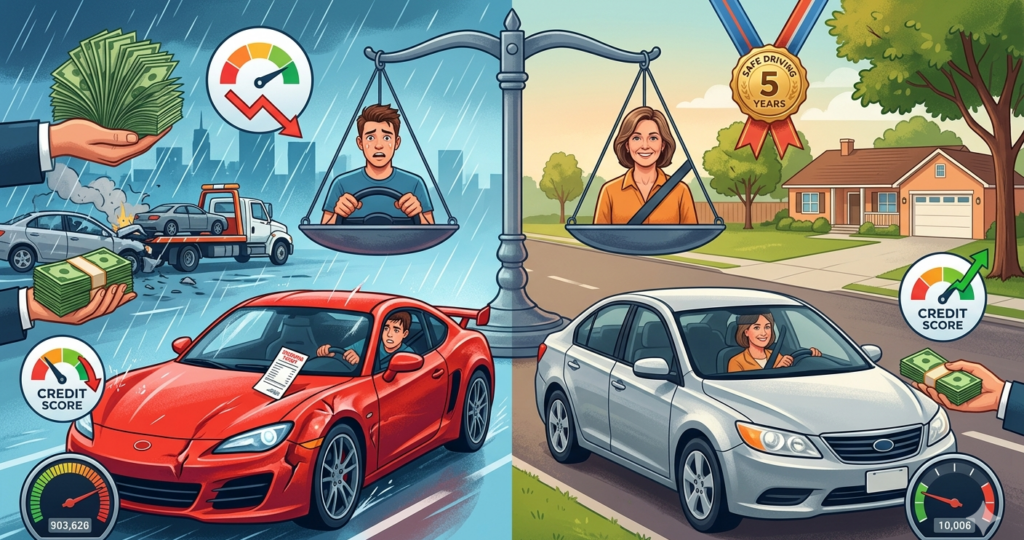
The Fundamental Principle Behind Every Car Insurance Quote
Before we dive into the specific factors, you need to understand the basic principle that drives every car insurance quote. Insurance is fundamentally about risk. An insurance company collects premiums from thousands of drivers, and it uses that money to pay claims for the small percentage of drivers who have accidents. To stay in business, the company must collect more in premiums than it pays out in claims plus its operating expenses.
This means that every driver is charged a premium that reflects how likely they are to have an accident and how expensive that accident is likely to be. Drivers who are statistically more likely to crash pay more. Drivers who are statistically less likely to crash pay less. It is not about fairness in a moral sense. It is about mathematics and probability.
The reason car insurance quotes vary so much between drivers is that these statistical probabilities vary dramatically based on dozens of factors. A seventeen year old male driver with a speeding ticket is vastly more likely to have an accident than a fifty year old female driver with a perfect record. The insurance company does not hate young men. It simply knows that young men file more claims, so it charges them more to cover those claims.
Understanding this principle is liberating because it removes the emotional reaction. You are not being punished. You are being priced according to statistical reality. And once you accept that, you can focus on the factors you can actually control.
Age and Driving Experience Are the Biggest Factors
If there is one factor that explains more variation in car insurance quotes than any other, it is age combined with driving experience. The statistics are clear and consistent across every insurance company in every state. Teenage drivers are the most likely to have accidents, and their accidents tend to be more severe. Drivers in their twenties are still riskier than average but less risky than teenagers. Drivers in their thirties and forties represent the safest group. Drivers over seventy begin to see their rates increase again as age related declines in vision and reaction time become factors.
For a first time driver who is seventeen or eighteen years old, car insurance quotes can be two to three times higher than for a similar driver who is thirty five. This is not because the teenager is a bad person. It is because the insurance company knows that teenagers are distracted more easily, have less experience judging distances and speeds, and are more likely to take risks like speeding or driving late at night. The statistics back this up completely.
The good news is that age works in your favor over time. Every year you drive without an accident, you become less risky in the eyes of insurers. The biggest drops typically happen at age twenty one, again at age twenty five, and again at age thirty. If you are a young driver paying high rates right now, take comfort in knowing that your quotes will naturally decrease as you gain experience and age out of the highest risk categories.
Location Matters More Than Most Drivers Realize
Where you park your car at night has a massive impact on your car insurance quotes. Drivers in densely populated cities pay significantly more than drivers in rural areas. Drivers in neighborhoods with high crime rates pay more than drivers in low crime areas. Drivers in states with no fault insurance laws pay more than drivers in traditional tort states. The variation based on location alone can be hundreds or even thousands of dollars per year.
The reason location matters so much is that insurers track claims data down to the zip code level, and in some cases down to the individual street. If you live in a zip code where car theft is common, your comprehensive coverage will be more expensive. If you live in a zip code where accidents happen frequently, your liability and collision coverage will be more expensive. If you live in a city with heavy traffic congestion, your risk of a fender bender increases dramatically.
This also explains why two drivers with identical profiles might receive very different quotes simply because they live on different sides of the same city. A driver in a suburban zip code with low crime and low traffic density might pay half of what a driver in an urban zip code with high crime and heavy traffic pays, even if they are the same age, drive the same car, and have the same driving record.
While you cannot always change where you live, understanding this factor can help you make better decisions. If you are considering a move, checking insurance rates in different zip codes could save you hundreds of dollars per year. Similarly, if you have access to a private garage instead of street parking, let your insurer know. Secure parking often qualifies for a discount.
Driving Record Is the One Factor You Control Most
Your driving record is the single most important factor that you have direct control over. Every accident, every speeding ticket, every moving violation stays on your record for three to five years depending on your state, and each one increases your car insurance quotes significantly. A single at fault accident can raise your premium by thirty to fifty percent. A speeding ticket might raise it by twenty to thirty percent. A DUI or reckless driving conviction can raise it by one hundred percent or more, and some insurers will refuse to cover you at all.
The reason driving record matters so much is simple. Past behavior is the best predictor of future behavior. A driver who has already had two accidents is statistically much more likely to have a third than a driver who has had none. Insurance companies do not judge you morally. They just follow the numbers.
The good news is that driving record is also the factor you can improve the most. Every year you drive without an accident or ticket, your old violations carry less weight. Most insurers only look back three years for minor violations and five years for major ones. If you have a poor driving record today, focus on driving safely for the next few years. Your car insurance quotes will drop significantly as those negative events fall off your record.
Some insurers also offer accident forgiveness programs, either as a standard feature or as an add on. With accident forgiveness, your first at fault accident does not raise your rates. This can be extremely valuable for drivers who are worried about a single mistake costing them for years. When comparing car insurance quotes, ask whether accident forgiveness is available and what it costs.
Credit Score Affects Your Rates in Most States
This is the factor that surprises most drivers. In the majority of states, insurance companies are allowed to use your credit based insurance score to determine your car insurance quotes. This is not exactly the same as your regular credit score, but it is derived from the same information. Insurers have found a strong statistical correlation between credit history and the likelihood of filing claims. Drivers with lower credit scores tend to file more claims and more expensive claims than drivers with higher credit scores.
The difference can be substantial. A driver with excellent credit might pay thirty to fifty percent less than a driver with poor credit for the exact same coverage. This is not because having bad credit makes you a worse driver. It is because the statistics show a correlation, and insurers are allowed to use that correlation in most states.
There are some important exceptions. California, Hawaii, Massachusetts, and Michigan have banned or severely restricted the use of credit scores in setting car insurance rates. If you live in one of these states, credit does not affect your quotes. In every other state, it does.
If your credit score is less than perfect, improving it can lead to lower car insurance quotes. Pay your bills on time, reduce your credit card balances, and avoid opening new credit accounts unnecessarily. Even small improvements in your credit score can translate into meaningful savings on your insurance. And if your credit has improved since you last bought a policy, ask your insurer to rerun your credit based insurance score. They will not do this automatically, but they will do it if you ask.
The Car You Drive Makes a Huge Difference
The vehicle you choose to drive has a massive impact on your car insurance quotes. Two drivers with identical profiles can receive wildly different quotes simply because one drives a safe, boring car and the other drives a sporty or luxury vehicle. Insurance companies look at several specific factors when rating your car.
The first factor is the car’s safety rating. Cars with high safety ratings and advanced safety features like automatic emergency braking, lane departure warnings, and blind spot monitoring often qualify for discounts. These features reduce the likelihood and severity of accidents, so insurers reward them.
The second factor is the car’s theft rate. Some vehicles are stolen much more frequently than others. Sports cars, luxury SUVs, and certain Honda and Toyota models are popular targets for thieves. If your car is on the frequently stolen list, your comprehensive coverage will be more expensive.
The third factor is the cost of repairs. Luxury cars and electric vehicles often have very expensive parts and require specialized repair facilities. If you damage a BMW or a Tesla, the repair bill will be much higher than for a Toyota Corolla. Insurers know this, so they charge higher collision and comprehensive premiums for expensive to repair vehicles.
The fourth factor is the car’s performance. Sports cars and high performance sedans are statistically involved in more accidents and more severe accidents than economy cars. A teenager driving a Ford Mustang will pay dramatically more than the same teenager driving a Honda Civic, even if both cars are worth the same amount.
If you are shopping for a new car and want to keep your insurance costs down, check insurance quotes for several models before you buy. The difference between the cheapest and most expensive car to insure can be more than one thousand dollars per year. Sites like the Insurance Institute for Highway Safety publish lists of the cheapest and most expensive cars to insure, and they are well worth consulting before making a purchase.
Marital Status and Household Composition
Your marital status affects your car insurance quotes in most states. Married drivers pay significantly less than single drivers of the same age, gender, and driving record. The statistics show that married drivers have fewer accidents and file fewer claims than their single counterparts. Insurers do not question why this is true. They simply observe the pattern and price accordingly.
The discount for being married can be ten to twenty percent in many cases. This is one reason why getting married often triggers a drop in car insurance rates. If you have recently gotten married, call your insurer and ask them to update your status. You might be eligible for an immediate discount.
Household composition also matters beyond just marital status. If you have teenage drivers in your household, your rates will increase significantly regardless of whether those teenagers are listed on your policy. Insurers assume that any licensed driver in your household has access to your vehicles, so they factor that risk into your premium. Some insurers allow you to exclude specific drivers from coverage if you can prove they have their own insurance or do not have access to your keys. This is called a named driver exclusion, and it can save you money if you have a teenager with their own car and their own policy.
Gender and Its Statistical Impact
Gender is one of the most controversial factors in car insurance pricing, but it is also one of the most statistically significant. Young male drivers pay significantly more than young female drivers of the same age. The reason is not discrimination in the emotional sense. It is pure statistics. Young men are involved in more accidents than young women, and their accidents tend to be more severe. They are also more likely to engage in risky behaviors like speeding, driving late at night, and driving under the influence.
The gap between young men and young women narrows as drivers age. By age thirty, the difference is minimal. By age forty, gender has almost no impact on rates. Some states, including California, Massachusetts, and Pennsylvania, have banned the use of gender in setting car insurance rates. In those states, men and women of the same age and driving record pay the same.
If you are a young male driver paying high rates, the most important thing to know is that this gap will shrink over time. Every year you drive without an accident brings you closer to the point where gender no longer matters. In the meantime, focus on the factors you can control, like your driving record, your credit score, and the car you drive.
Annual Mileage and How You Use Your Car
How much you drive and why you drive matters a great deal to insurance companies. A driver who commutes fifty miles each way on crowded highways is much more likely to have an accident than a driver who works from home and only drives five thousand miles per year for errands and leisure. Insurers track this by asking for your annual mileage and your primary use of the vehicle.
Most insurers offer low mileage discounts for drivers who drive less than seven thousand five hundred or ten thousand miles per year. If you drive significantly less than the average driver, make sure your insurer knows this. Some insurers, like Nationwide with their SmartMiles program, offer per mile policies that can be extremely cheap for very low mileage drivers.
Your primary use of the vehicle also matters. Commuting to work is considered higher risk than pleasure or leisure use because commuting typically happens during rush hour when roads are crowded. If you work from home or take public transit to work, you should classify your vehicle as pleasure use rather than commuting. This can lower your premium without changing your coverage at all.
If you use your vehicle for ridesharing services like Uber or Lyft, you need a special policy or endorsement. Standard personal auto insurance does not cover you while you are driving for a ridesharing company. If you have an accident while waiting for a passenger or driving someone to their destination, your personal policy will deny the claim. Many insurers now offer ridesharing endorsements at reasonable prices, but you must ask for them specifically.
The Cumulative Effect of Multiple Factors
One of the most important things to understand about why car insurance quotes vary so much between drivers is that factors do not operate in isolation. They combine and multiply each other. A young male driver with a poor credit score, a speeding ticket, and a sports car will pay dramatically more than the sum of each individual factor. The insurer sees this driver as high risk on multiple dimensions, and each dimension reinforces the others.
Conversely, a middle aged married female driver with excellent credit, a perfect driving record, and a safe economy car will pay dramatically less. She benefits from every possible discount and low risk classification. The difference between these two drivers can easily be three thousand dollars per year or more for the exact same coverage.
This cumulative effect explains why two drivers who seem similar on the surface can receive very different quotes. You might both be twenty five years old with clean records, but if you have a lower credit score and live in a busier zip code while your friend has excellent credit and lives in a quiet suburb, your quotes could differ by hundreds of dollars. The factors that are invisible to you are visible to the insurance company’s algorithm.
How to Use This Knowledge to Get Better Quotes
Understanding why car insurance quotes vary so much between drivers is valuable only if you use that knowledge to improve your own situation. Here are the most important actions you can take based on everything you have learned.
First, shop around at least every six months. Different insurers weigh the same factors differently. One company might heavily penalize a poor credit score, while another might be more forgiving but penalize your zip code more heavily. By getting quotes from multiple insurers, you increase your chances of finding the company whose algorithm favors your specific profile.
Second, focus on the factors you can change. You cannot change your age, your gender, or your past driving record overnight. But you can improve your credit score. You can drive safely to keep your record clean. You can choose a cheaper car to insure when you buy your next vehicle. You can move to a different neighborhood when your lease ends. You can get married if you are planning to do so anyway. Each of these changes will directly lower your quotes.
Third, be honest on your applications. Lying about your address, your annual mileage, or your driving record might get you a lower quote upfront, but it will be discovered if you file a claim. The insurer will deny the claim and cancel your policy, leaving you with no coverage exactly when you need it most. Honesty is not just ethical. It is practical.
Fourth, ask about every possible discount. Many drivers receive higher quotes than necessary simply because they never asked whether they qualify for a better rate. Ask about good student discounts, defensive driving discounts, low mileage discounts, bundling discounts, pay in full discounts, and professional organization discounts. The worst an agent can say is no. The best is a lower premium.
The Bottom Line on Why Car Insurance Quotes Vary So Much
Car insurance quotes vary so much between drivers because every driver represents a unique combination of risks. Age, driving record, credit score, location, the car you drive, your marital status, your gender, your annual mileage, and how you use your vehicle all feed into complex algorithms that predict your likelihood of filing a claim. The driver who looks like a low risk on all these dimensions pays very little. The driver who looks like a high risk on several dimensions pays much more.
This system is not personal. It is not unfair in the way many drivers initially assume. It is simply the mathematical reality of spreading risk across millions of policyholders. The good news is that you have more control than you might think. You can improve your credit score, maintain a clean driving record, choose a safe and cheap to insure vehicle, and shop around regularly to find the insurer that best matches your profile.
The next time you hear a friend or coworker mention how little they pay for car insurance, remember that their quote is based on their unique combination of factors, not on yours. Instead of feeling frustrated, use that energy to take action. Get new quotes today. Ask about discounts. And make a plan to improve the factors you can control over the next year. Your future self will thank you when you open that lower premium notice in the mail.