Buying a new car is one of life’s great thrills. That new car smell, the flawless paint, the dashboard that has never seen a coffee stain, the engine that purrs instead of rattles. But along with the excitement comes a new set of responsibilities. One of the most important is making sure you have the right insurance coverage for your brand new vehicle.
The coverage options you had on your old beater are not necessarily the right choices for your new car. A car that is worth thirty thousand dollars needs different protection than a car that is worth three thousand dollars. A car with a loan needs different coverage than a car you own outright. And a car with advanced safety and technology features needs insurance that understands the cost of repairing those sophisticated systems.
This article will walk you through every coverage option that new car owners need to know. You will learn which coverages are required, which are strongly recommended, and which you might be able to skip. You will also learn about special coverages designed specifically for new cars, like gap insurance and new car replacement. By the end, you will know exactly how to protect your investment without overpaying for coverage you do not need.
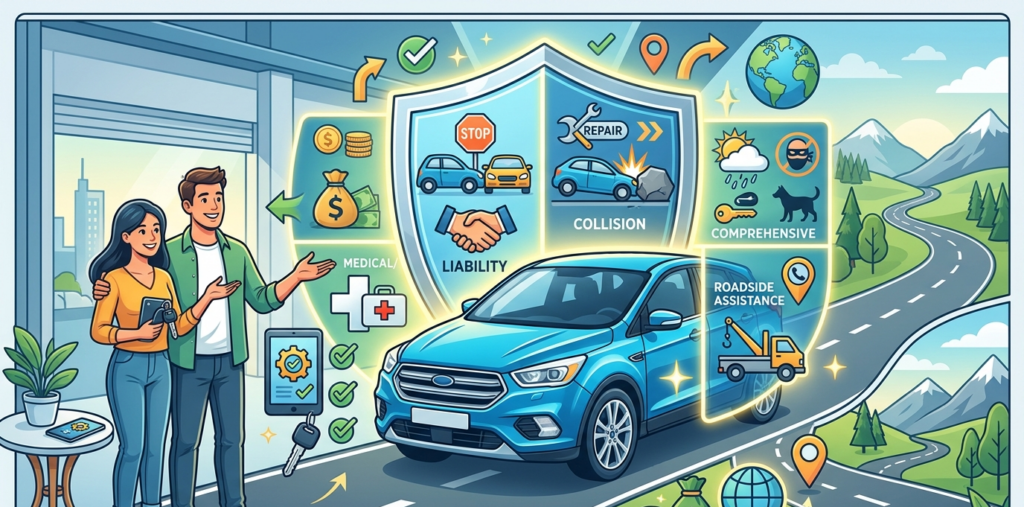
Why New Cars Need Different Insurance Than Old Cars
Before we dive into specific coverages, it helps to understand why new cars require different insurance considerations than older vehicles. The differences go far beyond just the car’s value, although that is certainly important.
A new car is worth significantly more than an old car. That means a total loss accident is much more expensive for your insurance company. If you total a five year old car worth eight thousand dollars, the insurer pays eight thousand dollars. If you total a brand new car worth thirty five thousand dollars, the insurer pays thirty five thousand dollars. That higher potential payout means higher premiums, but it also means you need stronger coverage to protect that larger investment.
A new car also has a loan or lease in most cases. Lenders and leasing companies require specific coverages to protect their investment. You cannot simply choose the cheapest policy. You must meet your lender’s requirements, which almost always include comprehensive and collision coverage.
A new car is also more expensive to repair. Modern cars are filled with sensors, cameras, radar units, and sophisticated electronics. A minor fender bender that might have cost one thousand dollars to repair on an older car could cost five thousand dollars on a new car because of recalibrated sensors and replacement cameras. Your insurance needs to account for these higher repair costs.
Here is a table comparing insurance considerations for new cars versus old cars.
| Factor | New Car | Old Car (5+ years) |
|---|---|---|
| Current value | $25,000 – $50,000+ | $3,000 – $10,000 |
| Loan or lease? | Usually yes | Usually no |
| Repair costs | Higher (sensors, cameras, electronics) | Lower (basic parts) |
| Comprehensive and collision | Required by lender | Optional |
| Gap insurance | Highly recommended | Not needed |
| New car replacement | Available and valuable | Not available |
| Deductible choice | Lower recommended | Higher acceptable |
Understanding these differences is the first step toward building the right insurance package for your new car.
Comprehensive and Collision: The Non Negotiable Coverages
If you have a loan or lease on your new car, comprehensive and collision coverage are not optional. Your lender requires them. But even if you paid cash for your new car, you should almost certainly carry both coverages. The reason is simple. A new car is a major financial investment. If you total it without comprehensive and collision coverage, you lose that entire investment.
Comprehensive coverage pays for damage to your car from theft, vandalism, weather, fire, animal strikes, and falling objects. Collision coverage pays for damage from crashing into another car or object. Together, they ensure that no matter how your car is damaged or destroyed, you are protected.
Here is a table showing the cost of comprehensive and collision coverage on a new car versus the potential loss without it.
| Car Value | Annual Comprehensive & Collision Premium | Years to Pay Premium = Car Value | Loss if Totaled Without Coverage |
|---|---|---|---|
| $35,000 | $800 | 44 years | $35,000 |
| $30,000 | $700 | 43 years | $30,000 |
| $25,000 | $600 | 42 years | $25,000 |
As the table shows, the annual premium for comprehensive and collision is a small fraction of your car’s value. Even if you keep the car for five years, you will pay only four thousand dollars in premiums to protect a thirty five thousand dollar asset. That is an excellent value.
When choosing comprehensive and collision coverage for a new car, pay attention to your deductibles. The deductible is the amount you pay out of pocket before insurance kicks in. A lower deductible means higher monthly premiums but lower out of pocket costs if you have an accident. For a new car, most experts recommend a deductible of five hundred dollars or less. You want to minimize your out of pocket expense if something happens to your expensive new vehicle.
Here is a table comparing deductible choices for a new car owner.
| Deductible | Monthly Premium (Estimate) | Out of Pocket After Accident | Best For |
|---|---|---|---|
| $250 | $75 | $250 | Drivers with limited savings |
| $500 | $65 | $500 | Most new car owners |
| $1,000 | $55 | $1,000 | Drivers with good savings |
| $2,500 | $45 | $2,500 | Drivers with strong savings |
The five hundred dollar deductible is the sweet spot for most new car owners. It balances affordable monthly payments against reasonable out of pocket costs.
Gap Insurance: Protecting Yourself From Depreciation
Gap insurance is one of the most important coverage options for new car owners, yet it is also one of the most misunderstood. Gap stands for guaranteed asset protection. In simple terms, gap insurance pays the difference between what your car is worth and what you still owe on your loan if your car is totaled.
Here is why gap insurance is so important for new car owners. New cars depreciate rapidly. The moment you drive your new car off the dealer lot, it loses ten to twenty percent of its value. By the end of the first year, your car might be worth only seventy to eighty percent of what you paid. Meanwhile, your loan balance is still close to the original purchase price. If your car is totaled during that first year, your standard collision coverage pays only the current value of the car, not what you owe. You could be left owing thousands of dollars on a car you can no longer drive.
Here is a real example to illustrate the problem. You buy a new car for thirty five thousand dollars. You put three thousand five hundred dollars down, which is ten percent. Your loan balance is thirty one thousand five hundred dollars. Six months later, you are in an accident and the car is totaled. Your car is now worth twenty eight thousand dollars due to depreciation. Your collision coverage pays twenty eight thousand dollars to your lender. You still owe three thousand five hundred dollars on the loan. Without gap insurance, you have to pay that three thousand five hundred dollars out of your own pocket. With gap insurance, your policy pays that three thousand five hundred dollars.
Here is a table showing how the gap changes over time for a typical new car loan.
| Time After Purchase | Car Value | Loan Balance | Gap (Difference) |
|---|---|---|---|
| 0 months (new) | $35,000 | $31,500 | -$3,500 (equity) |
| 6 months | $30,000 | $30,000 | $0 |
| 12 months | $27,000 | $28,000 | $1,000 |
| 18 months | $24,500 | $26,000 | $1,500 |
| 24 months | $22,000 | $23,500 | $1,500 |
| 36 months | $18,000 | $18,000 | $0 |
As the table shows, the gap is largest between about twelve and thirty months of ownership. This is when you are most vulnerable. After about three years, your loan balance and car value converge, and gap insurance becomes less valuable.
Gap insurance typically costs twenty to forty dollars per year when added to your auto policy. That is a small price to pay for protection against a potential one thousand to five thousand dollar loss. For new car owners with small down payments or long loan terms, gap insurance is strongly recommended.
You have two options for buying gap insurance. You can buy it from your car dealer when you purchase the vehicle, or you can add it to your auto insurance policy. Dealer gap insurance is often more expensive, sometimes several hundred dollars for a one time fee. Auto insurance gap insurance is usually much cheaper, typically twenty to forty dollars per year. Always compare prices before deciding.
New Car Replacement Coverage: Getting a Brand New Car After a Total Loss
New car replacement coverage is an optional endorsement that does exactly what its name suggests. If your new car is totaled, this coverage pays to replace it with a brand new car of the same make and model, not just the depreciated value of your current car.
Standard collision coverage pays the actual cash value of your car at the time of the accident. If your one year old car is totaled, you receive the current market value, which is significantly less than what you paid. New car replacement coverage pays the cost of a brand new replacement vehicle, including taxes and fees.
Here is a table comparing standard collision to new car replacement.
| Age of Car When Totaled | Standard Collision Payout | New Car Replacement Payout | Difference |
|---|---|---|---|
| 3 months | $32,000 (depreciated) | $35,000 (new) | $3,000 |
| 12 months | $27,000 (depreciated) | $35,000 (new) | $8,000 |
| 24 months | $22,000 (depreciated) | $35,000 (new) | $13,000 |
New car replacement coverage is not available for all cars or for all time periods. Most insurers limit this coverage to cars that are less than one or two years old and have less than fifteen thousand to twenty thousand miles. Some insurers offer it for up to three years. After that, the coverage typically expires.
The cost of new car replacement coverage varies by insurer but is typically ten to twenty percent of your comprehensive and collision premium. For a new car owner, this can be an excellent value, especially during the first two years of ownership when depreciation is most rapid.
However, if you already have gap insurance, you might not need new car replacement. Gap insurance covers the difference between your loan balance and the car’s value, while new car replacement gives you a brand new car. If your goal is to avoid being upside down on your loan, gap insurance is sufficient. If your goal is to drive a brand new car after a total loss regardless of your loan situation, new car replacement is better. Some drivers buy both.
OEM Endorsement: Ensuring Factory Parts for Repairs
One of the most overlooked coverage options for new car owners is the OEM endorsement. OEM stands for original equipment manufacturer. This endorsement ensures that any replacement parts used to repair your car after an accident are genuine factory parts, not aftermarket parts.
Here is why this matters for new car owners. Aftermarket parts are made by third party companies, not by your car’s manufacturer. They are often cheaper than OEM parts, which is why insurance companies prefer to use them. However, aftermarket parts may not fit perfectly, may not perform as well, and may affect your car’s safety systems. For a new car, you want genuine factory parts to maintain the car’s integrity, safety, and resale value.
Here is a table comparing OEM parts to aftermarket parts.
| Factor | OEM Parts (Factory) | Aftermarket Parts (Third Party) |
|---|---|---|
| Fit and finish | Exact match | May require adjustment |
| Quality control | Manufacturer standards | Varies by supplier |
| Safety system compatibility | Guaranteed | May not calibrate correctly |
| Warranty | Covered by manufacturer | Limited or no warranty |
| Resale value impact | No impact | Potential reduction |
| Cost | Higher | Lower (20-50% less) |
Without the OEM endorsement, your insurer has the right to use aftermarket parts for repairs. With the endorsement, they must use OEM parts. The endorsement typically adds ten to twenty percent to your comprehensive and collision premium. For a new car owner, this is often worth the cost to ensure your car is repaired to factory standards.
Some insurers offer a similar endorsement called factory authorized parts or original equipment parts. The specific name varies, but the concept is the same. Ask your agent about OEM parts coverage when insuring a new car.
Windshield and Glass Coverage: Protection From Road Debris
If you have ever driven a new car on a highway, you know the sickening sound of a rock hitting your windshield. That tiny chip can spread into a crack that requires a full windshield replacement. For new cars, windshield replacement is especially expensive because modern windshields often include sensors for rain sensing wipers, lane departure warnings, and forward collision detection.
Comprehensive coverage typically covers windshield damage, but with a deductible. If you have a five hundred dollar deductible and a windshield replacement costs eight hundred dollars, you pay five hundred dollars and your insurance pays three hundred dollars. That is not great. Zero deductible glass coverage, often called full glass coverage, eliminates the deductible entirely. Your windshield is repaired or replaced at no cost to you.
Here is a table showing the value of zero deductible glass coverage for new car owners.
| Car Type | Windshield Replacement Cost | With $500 Deductible | With $0 Glass Coverage |
|---|---|---|---|
| Economy car | $300 – $500 | You pay $300-500 | You pay $0 |
| Mid-size sedan | $500 – $800 | You pay $500 | You pay $0 |
| Luxury car | $800 – $1,500 | You pay $500 | You pay $0 |
| Car with heads-up display | $1,000 – $2,000 | You pay $500 | You pay $0 |
| Car with camera/sensor array | $1,200 – $2,500 | You pay $500 | You pay $0 |
Many new cars fall into the bottom two rows of this table. The advanced safety features that make new cars so safe also make them expensive to repair. Zero deductible glass coverage typically costs five to fifteen dollars per year. For new car owners, it is almost always worth the small additional cost.
Some states, like Florida, Kentucky, and South Carolina, require insurers to offer zero deductible glass coverage. In other states, it is optional. Check your policy or ask your agent whether you have this coverage.
Accident Forgiveness: Protecting Your Future Rates
Accident forgiveness is an endorsement that prevents your insurance rates from increasing after your first at fault accident. Normally, an at fault accident can raise your premium by thirty to fifty percent for three to five years. Accident forgiveness waives that increase.
For new car owners, accident forgiveness is particularly valuable because your rates are already higher due to the car’s value. An accident that raises your premium by forty percent could cost you hundreds of dollars per year for several years. Accident forgiveness protects you from that financial hit.
Here is a table showing the financial benefit of accident forgiveness for a new car owner.
| Scenario | Annual Premium Before Accident | Annual Premium After Accident (3 years) | Total Extra Cost Over 3 Years |
|---|---|---|---|
| Without accident forgiveness | $1,500 | $2,100 (+40%) | $1,800 |
| With accident forgiveness | $1,500 | $1,500 (0% increase) | $0 |
Some insurers offer accident forgiveness as a standard feature for long term customers. Others offer it as an optional endorsement that costs twenty to fifty dollars per year. For new car owners, especially those who are younger or who live in congested areas, accident forgiveness is often worth the cost.
There is an important distinction to understand between two types of accident forgiveness. Some insurers offer accident forgiveness that applies immediately, meaning your first accident regardless of when it happens is forgiven. Others offer accident forgiveness that only applies after you have been accident free for a certain number of years, typically three to five. Read the fine print or ask your agent which type you are buying.
Rental Reimbursement: Staying Mobile While Your New Car Is Repaired
If your new car is in the shop after an accident, you still need to get to work, run errands, and live your life. Rental reimbursement coverage pays for a rental car while your car is being repaired. For new car owners, this coverage is especially valuable because new car repairs often take longer than older car repairs. Parts may need to be ordered. Specialty shops may be required. The repair process for a new car with advanced systems can stretch from days into weeks.
Rental reimbursement typically pays a certain amount per day, usually twenty to fifty dollars, for up to thirty days per accident. For a new car owner, you want a higher daily limit because you want a comparable rental car, not the smallest economy car available.
Here is a table comparing rental reimbursement options for new car owners.
| Daily Limit | Monthly Premium (Estimate) | Rental Car You Can Get | Coverage Duration |
|---|---|---|---|
| $30/day | $4 | Economy or compact car | 30 days |
| $40/day | $6 | Mid-size sedan | 30 days |
| $50/day | $8 | Standard or full-size car | 30 days |
| $60/day | $10 | SUV or premium car | 30 days |
For a new car owner, a forty or fifty dollar per day limit is recommended. This ensures you can rent a car comparable to your own vehicle while yours is being repaired. The extra two to four dollars per month is well worth the convenience.
Roadside Assistance: Peace of Mind for the Unpredictable
Even new cars break down. A dead battery, a flat tire, or running out of gas can happen to anyone, regardless of how new the car is. Roadside assistance covers the cost of towing, jump starts, lockout service, flat tire changes, and fuel delivery.
For new car owners, many manufacturers include roadside assistance for the first few years of ownership. Check your owner’s manual or ask your dealer. If you already have manufacturer roadside assistance, you do not need to buy it from your insurer. However, manufacturer roadside assistance may have limitations. Some only cover towing to the nearest dealer. Some have limited mileage. Some expire after a certain number of uses.
Here is a table comparing manufacturer roadside assistance to insurer roadside assistance.
| Feature | Manufacturer Roadside | Insurer Roadside Assistance |
|---|---|---|
| Cost | Included in purchase price | $10-30 per year |
| Duration | Typically 2-5 years | As long as you have the policy |
| Towing distance | Often limited to nearest dealer | Usually 5-15 miles |
| Number of calls | Limited (often 4-6 per year) | Varies by insurer |
| Claims affect rates? | No | Possibly (depends on insurer) |
If your manufacturer roadside assistance is still active, you can skip buying it from your insurer. Once it expires, consider adding it. The cost is low, and the peace of mind is valuable for new car owners who want to avoid the hassle and expense of a breakdown.
Coverages New Car Owners Can Probably Skip
Not every coverage option is right for new car owners. Some coverages are designed for older cars or specific situations that do not apply to new vehicles. Understanding what you do not need is just as important as understanding what you do need.
Pay per mile insurance is a bad choice for most new car owners. These policies charge a low daily base rate plus a few cents per mile. New car owners typically drive their new cars more than average because they enjoy driving them. The per mile charges add up quickly. A traditional policy is almost always cheaper for new car owners.
Classic car insurance is not for new cars. These policies are designed for collectible vehicles that are driven very few miles per year. They often have mileage limits and storage requirements that new car owners cannot meet.
Medical payments coverage may be less important if you have good health insurance. While MedPay is still valuable for covering deductibles and copays, your health insurance should cover most accident related medical bills. For new car owners with good health coverage, you might choose a lower MedPay limit or skip it entirely. However, if you frequently drive passengers who might not have health insurance, MedPay is still valuable.
Here is a summary table of coverages new car owners can probably skip or reduce.
| Coverage | Why New Car Owners Can Skip It | Exception |
|---|---|---|
| Pay per mile insurance | High mileage makes it expensive | If you drive less than 5,000 miles/year |
| Classic car insurance | New cars are not classics | If you buy a second classic car |
| High medical payments | Good health insurance may cover | If passengers lack health insurance |
| Low liability limits | New cars deserve higher protection | Never recommended |
Putting It All Together: The Ideal New Car Owner Policy
Now that you understand all the coverage options, let us put together an ideal policy for a new car owner. This is a recommendation for most people buying a new car with a loan or lease. Your specific situation may vary, but this is an excellent starting point.
Start with liability coverage at one hundred thousand dollars per person and three hundred thousand dollars per accident. New cars are often driven more and carry more risk. Higher limits protect your assets.
Add comprehensive and collision coverage with a five hundred dollar deductible. Your lender requires these, and even if they did not, you should carry them to protect your investment.
Add gap insurance. Unless you put twenty percent or more down on your car, gap insurance protects you from being upside down on your loan.
Add new car replacement coverage if available. This gives you a brand new car if yours is totaled in the first year or two.
Add the OEM endorsement to ensure factory parts for repairs. This protects your car’s safety systems and resale value.
Add zero deductible glass coverage. For a few dollars per year, you avoid hundreds of dollars in out of pocket costs for windshield repairs and replacements.
Add accident forgiveness. This protects your rates from increasing after your first at fault accident.
Add rental reimbursement at forty or fifty dollars per day. This keeps you in a comparable car while yours is being repaired.
Add roadside assistance if your manufacturer coverage has expired or is limited.
Here is a summary table of the ideal new car owner policy with estimated annual premiums for a thirty five thousand dollar car.
| Coverage | Recommended Limit | Estimated Annual Premium |
|---|---|---|
| Liability | $100k/$300k | $450 |
| Uninsured/underinsured | $100k/$300k | $90 |
| Comprehensive | $500 deductible, $0 glass | $200 |
| Collision | $500 deductible | $400 |
| Gap insurance | Included | $35 |
| New car replacement | First 2 years | $100 |
| OEM endorsement | Factory parts only | $50 |
| Accident forgiveness | First accident | $40 |
| Rental reimbursement | $40/day for 30 days | $70 |
| Roadside assistance | Standard | $25 |
| Total | $1,460 |
This total of about one thousand four hundred sixty dollars per year, or one hundred twenty two dollars per month, provides comprehensive protection for your new car. You can adjust deductibles and limits based on your budget, but this package covers all of the most important coverage options for new car owners.
The Bottom Line on Coverage Options for New Car Owners
Buying a new car is a major financial investment. Protecting that investment with the right insurance coverage is essential. New car owners need different coverage than owners of older vehicles. The higher value, the presence of a loan or lease, the expensive repair costs, and the rapid depreciation all require specific coverages.
The most important coverage options for new car owners are comprehensive and collision coverage with reasonable deductibles, gap insurance to protect against depreciation, new car replacement coverage for the first few years, the OEM endorsement for factory parts, zero deductible glass coverage, accident forgiveness, rental reimbursement, and roadside assistance.
The coverage options new car owners can probably skip include pay per mile insurance, classic car insurance, and excessive medical payments if you already have good health insurance.
The key insight is that the small additional cost for these coverages is money well spent. Gap insurance costs twenty to forty dollars per year but can save you thousands. Zero deductible glass costs five to fifteen dollars per year but can save you hundreds. Accident forgiveness costs forty dollars per year but can save you over one thousand dollars in increased premiums after an accident.
When you drive a new car, drive with confidence knowing that you have the right coverage. Take the time to review your policy, ask about the endorsements mentioned in this article, and make sure you are fully protected. Your new car deserves nothing less.