If you drive every day, you already know that the road can be unpredictable. You share the asphalt with distracted teenagers, tired commuters, hurried delivery drivers, and the occasional person who seems to have forgotten every rule of the road. As a daily driver, your exposure to risk is much higher than someone who drives once a week to the grocery store. Every time you buckle up, you are rolling the dice on whether today is the day someone runs a red light, drifts into your lane, or slams into the back of your car at a stoplight.
Given this reality, having the right car insurance coverages is not just a good idea. It is essential for protecting your financial future. But not all coverages are created equal. Some are critical for daily drivers. Others are nice to have but not essential. And some are a waste of money for most people. The key is knowing which coverages deliver the most value for the miles you drive.
This article will identify the most valuable car insurance coverages for daily drivers. You will learn which coverages you should never drive without, which ones are worth the extra cost, and which ones you can safely skip. You will also learn how to balance protection against affordability so you are not paying for coverage you do not need while staying fully protected where it matters most.
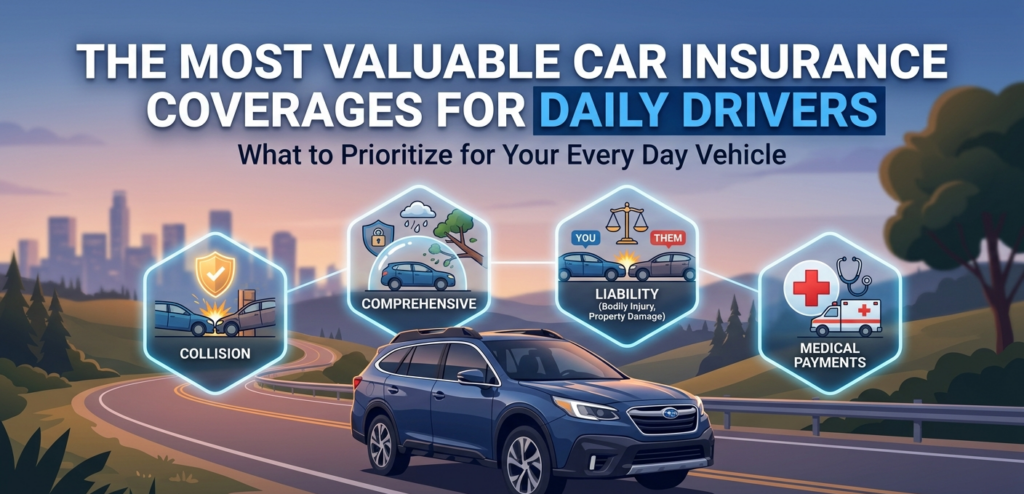
Why Daily Drivers Need Different Coverage Than Occasional Drivers
Before we dive into specific coverages, it helps to understand why daily drivers have different insurance needs than occasional drivers. The simple answer is math. The more you drive, the more likely you are to have an accident. This is not a judgment on your driving skills. It is pure probability.
A daily driver who commutes fifty miles round trip, five days per week, drives about thirteen thousand miles per year. An occasional driver who drives only on weekends might drive three thousand miles per year. The daily driver is on the road more than four times as much, which means they have more than four times the opportunities to be in an accident. Their risk of being hit by an uninsured driver, hitting a deer, or being involved in a multi car pileup is proportionally higher.
Here is a table showing how annual mileage affects accident probability.
| Annual Mileage | Driving Profile | Estimated Accident Probability per Year |
|---|---|---|
| 3,000 | Occasional driver (weekends only) | 3% |
| 6,000 | Light commuter (short trips) | 6% |
| 10,000 | Average driver | 10% |
| 13,000 | Daily commuter | 13% |
| 18,000 | Long distance commuter | 18% |
| 25,000+ | Sales or delivery driver | 25%+ |
Because daily drivers face higher accident probabilities, the value of strong coverage is higher. The same five hundred dollar annual premium for comprehensive coverage provides more expected benefit to a daily driver than to an occasional driver because the daily driver is more likely to use it.
Daily drivers also face higher exposure to uninsured drivers, more opportunities for windshield damage from highway debris, and greater likelihood of mechanical breakdowns that require roadside assistance. All of these factors make certain coverages much more valuable for daily drivers than for the general population.
Liability Coverage: The Non Negotiable Foundation
Liability coverage is the most important coverage for any driver, but it is especially critical for daily drivers. The reason is simple. Daily drivers cause more accidents simply by being on the road more. Not because they are bad drivers. Because they have more chances to make a mistake or to be put in a situation where an accident is unavoidable.
When you cause an accident, your liability coverage pays for the other driver’s medical bills and car repairs. If your liability limits are too low, you could be personally responsible for tens of thousands of dollars. For a daily driver, the risk of causing a serious accident is higher, so the consequences of inadequate liability coverage are more severe.
The state minimum liability limits in most states are dangerously low for daily drivers. Fifteen thousand or twenty five thousand dollars per person might cover a few hours in the emergency room, but it will not cover surgery, physical therapy, or long term care. A serious accident with multiple injured people could easily exceed one hundred thousand dollars in medical bills alone.
Here is a table showing why daily drivers need higher liability limits than occasional drivers.
| Liability Limit | Monthly Premium (Estimate) | Protection After a Serious Accident |
|---|---|---|
| $25k/$50k (state minimum) | $45 | You pay everything over $25k per person |
| $50k/$100k | $55 | You pay everything over $50k per person |
| $100k/$300k | $65 | You pay everything over $100k per person |
| $250k/$500k | $80 | You pay everything over $250k per person |
| $500k/$1M (umbrella ready) | $100 | You pay everything over $500k per person |
For an extra twenty dollars per month, you can increase your liability coverage from state minimum to one hundred thousand dollars per person. That twenty dollars buys you protection against potentially hundreds of thousands of dollars in personal liability. For a daily driver, that is one of the best bargains in all of personal finance.
Most experts recommend that daily drivers carry at least one hundred thousand dollars per person and three hundred thousand dollars per accident in bodily injury liability. If you have significant assets, you should consider two hundred fifty thousand dollars or five hundred thousand dollars. The extra cost is minimal compared to the protection.
Uninsured and Underinsured Motorist Coverage: Protecting Yourself From Others
If you drive every day, the odds are good that you will eventually share the road with an uninsured driver. In some states, one in four drivers has no insurance at all. In every state, the number is higher than most drivers realize. Uninsured and underinsured motorist coverage protects you when one of these drivers hits you.
Here is a table showing the percentage of uninsured drivers in various states.
| State | Percentage of Uninsured Drivers | Rank (Highest to Lowest) |
|---|---|---|
| Florida | 26.7% | 1st |
| Mississippi | 25.9% | 2nd |
| New Mexico | 24.9% | 3rd |
| Michigan | 24.5% | 4th |
| Tennessee | 23.7% | 5th |
| California | 16.6% | 15th |
| Texas | 14.1% | 20th |
| New York | 13.5% | 25th |
| Ohio | 12.4% | 30th |
| Maine | 5.2% | 50th |
If you live in a state with high uninsured driver rates, UM/UIM coverage is essential. But even if you live in a state with lower rates, daily drivers face higher exposure simply because they are on the road more. A driver who covers thirteen thousand miles per year is much more likely to encounter an uninsured driver than a driver who covers three thousand miles.
UM/UIM coverage is surprisingly inexpensive. For most drivers, adding one hundred thousand dollars in UM/UIM coverage costs five to fifteen dollars per month. That small amount buys you protection against medical bills, lost wages, and pain and suffering if you are hit by an uninsured driver.
The best approach is to carry UM/UIM coverage at the same limits as your liability coverage. If you carry one hundred thousand dollars per person in liability, carry one hundred thousand dollars per person in UM/UIM. This ensures that you are protected to the same level that you protect others.
Medical Payments Coverage: Paying Your Medical Bills Fast
Medical payments coverage, or MedPay, is one of the most underrated coverages for daily drivers. It pays your medical bills after an accident regardless of who caused the accident. No waiting for fault determination. No dealing with the other driver’s insurance company. You simply submit your bills and get paid.
For daily drivers, MedPay is especially valuable because the likelihood of being in an accident is higher. Even if you are a perfect driver, you cannot control the other drivers on the road. A rear end collision at a stoplight can happen to anyone. When it does, you want your medical bills paid quickly.
MedPay also covers your passengers. If you carpool with coworkers or drive your children to school, MedPay ensures that their medical bills are covered regardless of who caused the accident. This is especially important if your passengers do not have health insurance or have high deductible health plans.
Here is a table showing the cost and benefit of different MedPay limits.
| MedPay Limit | Monthly Premium (Estimate) | Out of Pocket After a $10,000 Hospital Bill |
|---|---|---|
| $0 (no coverage) | $0 | $10,000 (you pay) |
| $5,000 | $5 | $5,000 |
| $10,000 | $8 | $0 (if health insurance pays the rest) |
| $25,000 | $12 | $0 |
For most daily drivers, five thousand or ten thousand dollars in MedPay is the sweet spot. The cost is low, and it covers the typical deductibles and copays that your health insurance would leave you with. If you have a high deductible health plan of five thousand dollars or more, matching your MedPay to your health insurance deductible is a smart strategy.
One thing to note is that MedPay is secondary to your health insurance in most cases. This means your health insurance pays first, and MedPay pays your deductibles, copays, and any remaining balance. If you do not have health insurance, MedPay becomes your primary coverage for accident related injuries, making it even more valuable.
Comprehensive Coverage: Protection From the Unexpected
Comprehensive coverage is often overlooked by daily drivers, but it is surprisingly valuable for people who spend a lot of time on the road. While comprehensive covers theft, vandalism, and weather damage, it also covers two things that daily drivers are especially vulnerable to: windshield damage and animal strikes.
If you drive on highways regularly, you will eventually get a rock chip in your windshield. It is not a matter of if, but when. Highway construction, loose gravel, and even normal road debris can send small rocks flying into your windshield. A minor chip can often be repaired for free under comprehensive coverage. A large crack requires a full windshield replacement, which can cost three hundred to one thousand dollars or more depending on your car.
Here is a table showing common comprehensive claims for daily drivers.
| Type of Claim | Typical Cost | How Common for Daily Drivers |
|---|---|---|
| Windshield chip repair | $50-150 | Very common (every 1-3 years) |
| Windshield replacement | $300-1,000 | Common (every 3-5 years) |
| Hitting a deer | $2,000-6,000 | Uncommon but serious |
| Hail damage | $1,000-5,000 | Depends on location |
| Theft of vehicle | $5,000-30,000 | Uncommon but catastrophic |
Many comprehensive policies offer zero deductible glass coverage, which means your windshield is repaired or replaced at no cost to you. This is extremely valuable for daily drivers who face constant exposure to road debris. For an extra five to ten dollars per year, zero deductible glass coverage can save you hundreds of dollars over the life of your policy.
Animal strikes are another risk that increases with mileage. Hitting a deer, a dog, or other large animal can cause thousands of dollars in damage to your car. Comprehensive coverage covers these strikes, while collision coverage does not. If you drive in rural areas or even suburban areas with wildlife, comprehensive coverage is essential.
Collision Coverage: Protecting Your Investment in Your Car
Collision coverage pays for damage to your car from crashes. For daily drivers, the value of collision coverage depends heavily on the value of your car and your financial situation. But there are some specific factors that make collision coverage more valuable for daily drivers than for occasional drivers.
The first factor is wear and tear. Daily drivers put more miles on their cars, which means their cars are worth less at any given age compared to low mileage cars. However, the cost to repair a car after an accident does not depend on mileage. A dented fender costs the same to repair whether the car has fifty thousand miles or one hundred fifty thousand miles. This means that collision coverage can be worth keeping longer on a high mileage car than the standard three thousand to five thousand dollar rule suggests.
The second factor is loan status. Many daily drivers finance their cars for longer terms because they drive more miles and want newer, more reliable vehicles. If you have a car loan, your lender requires collision coverage. This is non negotiable. But even if your loan is paid off, the daily use of your car makes it more valuable to you than its market value might suggest. If your car is totaled, you need a replacement immediately to get to work. Collision coverage ensures you have the money to buy that replacement.
Here is a table to help daily drivers decide whether to keep collision coverage.
| Car Value | Annual Collision Premium | Years to Pay Premium = Car Value | Keep Collision? |
|---|---|---|---|
| $10,000 | $400 | 25 years | Yes |
| $7,000 | $400 | 17.5 years | Yes |
| $5,000 | $400 | 12.5 years | Probably |
| $3,000 | $400 | 7.5 years | Consider dropping |
| $2,000 | $400 | 5 years | Consider dropping |
| $1,000 | $400 | 2.5 years | Drop |
The key insight is that collision coverage provides the most value when you cannot easily afford to replace your car out of pocket. If you are a daily driver and your car is essential to your ability to work, you should strongly consider keeping collision coverage even on an older car. The cost of missing work while you save for a replacement car can far exceed the annual premium.
Roadside Assistance: The Daily Driver’s Best Friend
If there is one coverage that daily drivers appreciate more than any other, it is roadside assistance. When you drive every day, the odds of a breakdown, a dead battery, a flat tire, or running out of gas increase dramatically. These events are not just inconvenient. They can make you late for work, miss an important meeting, or strand you in an unsafe area.
Roadside assistance covers the cost of towing, jump starts, lockout service, flat tire changes, and fuel delivery. For a daily driver, these services are not luxuries. They are necessities. The cost of a single tow can exceed the annual premium for roadside assistance.
Here is a table comparing the cost of roadside assistance through your insurer versus paying out of pocket.
| Service | Average Out of Pocket Cost | Cost with Roadside Assistance |
|---|---|---|
| Tow (5 miles) | $75-150 | $0 |
| Tow (10 miles) | $100-200 | $0 |
| Jump start | $50-100 | $0 |
| Lockout service | $75-150 | $0 |
| Flat tire change | $50-100 | $0 |
| Fuel delivery | $50-100 | $0 |
Roadside assistance typically costs ten to thirty dollars per year through your car insurance company. For that small amount, you get peace of mind knowing that if your car breaks down on the way to work, help is a phone call away. For daily drivers, this is one of the best values in car insurance.
One important note is that some insurers count roadside assistance calls as claims. If you use roadside assistance multiple times per year, your insurer might increase your rates or even non renew your policy. For this reason, some daily drivers prefer to use AAA or another standalone motor club. The cost is slightly higher, but the claims do not affect your insurance record. Compare both options before deciding.
Rental Reimbursement: Staying Mobile While Your Car Is Repaired
If your car is in the shop after an accident, how do you get to work? How do you pick up your kids? How do you run errands? For daily drivers, a car is not a luxury. It is a necessity. Rental reimbursement coverage pays for a rental car while your car is being repaired after an accident.
Without rental reimbursement, you have to pay for a rental car out of pocket. Rental cars typically cost thirty to sixty dollars per day, plus taxes and fees. If your car takes two weeks to repair, that is four hundred twenty to eight hundred forty dollars. With rental reimbursement, you pay nothing or only a small daily copay.
Here is a table showing the cost and benefit of rental reimbursement for daily drivers.
| Rental Reimbursement Limit | Monthly Premium (Estimate) | Coverage | Out of Pocket for 2 Week Rental |
|---|---|---|---|
| $0 (no coverage) | $0 | $0 | $500-800 |
| $30/day for 30 days | $4 | $900 max | $0 |
| $40/day for 30 days | $6 | $1,200 max | $0 |
| $50/day for 30 days | $8 | $1,500 max | $0 |
For daily drivers, the thirty dollars per day limit is usually sufficient for a standard sedan. If you need a larger vehicle for family or work purposes, consider forty or fifty dollars per day. The extra cost is minimal.
One thing to understand is that rental reimbursement only applies when your car is being repaired due to an accident covered by your policy. It does not cover rentals for routine maintenance, breakdowns, or vacations. For daily drivers focused on getting to work, this is exactly the coverage you need.
Gap Insurance: Protection for New Car Daily Drivers
If you drive a new car every day, you are taking a depreciation hit every time you turn the key. New cars lose ten to twenty percent of their value the moment you drive them off the lot. By the end of the first year, your car might be worth only seventy to eighty percent of what you owe on your loan. If your car is totaled in an accident during that first year, your standard collision coverage pays only the current value of the car, not what you owe. You could be left owing thousands of dollars on a car you can no longer drive.
Gap insurance covers that difference. It pays the gap between what your car is worth and what you still owe on your loan. For daily drivers who buy new cars and plan to keep them for many years, gap insurance is especially valuable during the first two to three years of ownership.
Here is a table showing how much gap insurance can save you in different scenarios.
| Time Since Purchase | Loan Balance | Car Value | Gap | Gap Insurance Cost (Annual) | Savings if Totaled |
|---|---|---|---|---|---|
| 0 months (new) | $30,000 | $24,000 | $6,000 | $30 | $6,000 |
| 12 months | $27,000 | $20,000 | $7,000 | $30 | $7,000 |
| 24 months | $23,000 | $17,000 | $6,000 | $30 | $6,000 |
| 36 months | $18,000 | $14,000 | $4,000 | $30 | $4,000 |
Gap insurance typically costs twenty to forty dollars per year when added to your auto policy. That is a small price to pay for protection against a five thousand dollar or larger loss. For daily drivers who put a lot of miles on new cars, the risk of being upside down on your loan is even higher because your car depreciates faster with higher mileage. Gap insurance is strongly recommended for these drivers.
Coverages Daily Drivers Can Probably Skip
Not every coverage is valuable for daily drivers. Some coverages are better suited for occasional drivers, collectors, or people with very specific needs. Understanding what you do not need is just as important as understanding what you do need.
Pay per mile insurance is a bad deal for daily drivers. These policies charge a low daily base rate plus a few cents per mile. If you drive thirteen thousand miles per year, you will pay significantly more than a traditional policy. Pay per mile is designed for drivers who drive less than five thousand miles per year. Daily drivers should avoid it.
New car replacement coverage is valuable for the first year or two of ownership, but it becomes less valuable as your car ages. This coverage pays to replace your totaled car with a brand new car of the same model, not just the depreciated value. For daily drivers who plan to keep their cars for many years, the extra cost may not be worth it after the first year. Consider buying it for the first year only, then dropping it.
Custom parts and equipment coverage is only valuable if you have made significant modifications to your car. If you have aftermarket wheels, a custom sound system, or other expensive modifications, this coverage protects them. For most daily drivers driving factory standard cars, you do not need this coverage.
Here is a summary table of coverages daily drivers can probably skip.
| Coverage | Why Daily Drivers Can Skip It | Exception |
|---|---|---|
| Pay per mile insurance | High mileage makes it expensive | None for most daily drivers |
| New car replacement (after year 2) | Car is no longer new | If you trade in every 1-2 years |
| Custom parts and equipment | Most daily drivers have stock cars | If you have expensive modifications |
| Classic car insurance | Daily drivers are not classics | If you have a second classic car |
Putting It All Together: The Ideal Daily Driver Policy
Now that you understand which coverages are most valuable for daily drivers, let us put together an ideal policy. This is a recommendation for most daily drivers. Your specific situation may vary, but this is an excellent starting point.
Start with liability coverage at one hundred thousand dollars per person and three hundred thousand dollars per accident. This is the foundation of your policy. Do not go lower.
Add uninsured and underinsured motorist coverage at the same limits. The cost is low, and the protection is essential for daily drivers.
Add medical payments coverage of five thousand to ten thousand dollars. This covers your health insurance deductibles and copays.
Add comprehensive coverage with zero deductible glass. The glass coverage alone is worth the price for daily drivers.
Add collision coverage if your car is worth more than three thousand dollars or if you cannot afford to replace it out of pocket.
Add roadside assistance. For twenty dollars per year, the peace of mind is invaluable.
Add rental reimbursement at thirty dollars per day for thirty days. This keeps you mobile while your car is being repaired.
Add gap insurance if you have a car loan and put less than twenty percent down or if your loan term is longer than five years.
Here is a summary table of the ideal daily driver policy with estimated annual premiums.
| Coverage | Recommended Limit | Estimated Annual Premium |
|---|---|---|
| Liability | $100k/$300k | $400 |
| Uninsured/underinsured | $100k/$300k | $80 |
| Medical payments | $5,000 | $60 |
| Comprehensive | Actual cash value, $500 deductible, $0 glass | $150 |
| Collision | Actual cash value, $500 deductible | $300 |
| Roadside assistance | Standard | $20 |
| Rental reimbursement | $30/day for 30 days | $40 |
| Gap insurance | Optional if financed | $30 |
| Total | $1,080 |
This total of about one thousand eighty dollars per year, or ninety dollars per month, provides excellent protection for a daily driver. You can adjust deductibles and limits based on your budget and savings, but this package covers all of the most valuable coverages for daily driving.
The Bottom Line on Valuable Coverages for Daily Drivers
Daily drivers face higher risks than occasional drivers. More time on the road means more chances for accidents, more exposure to uninsured drivers, more windshield damage, more animal strikes, more breakdowns, and more need for rental cars while your vehicle is being repaired. The right insurance coverages protect you against these increased risks.
The most valuable coverages for daily drivers are liability at higher limits, uninsured and underinsured motorist coverage, medical payments, comprehensive with zero deductible glass, roadside assistance, and rental reimbursement. Collision and gap insurance are also valuable depending on your car’s value and loan status.
The coverages that daily drivers can probably skip include pay per mile insurance and custom parts coverage. New car replacement is valuable only for the first year or two.
The key insight is that the small additional cost for strong coverage is money well spent for daily drivers. The extra twenty or thirty dollars per month for higher limits and additional coverages provides protection against financial disaster. When you drive every day, you cannot afford to gamble with inadequate insurance. Invest in the coverages that deliver the most value for your daily drive, and you will have peace of mind every time you turn the key.