If you have ever looked at a car insurance policy and felt completely lost, you are not alone. The language of car insurance is filled with confusing terms, strange names, and legal phrases that seem designed to make simple things complicated. Liability, collision, comprehensive, uninsured motorist, medical payments, gap insurance, personal injury protection. What do all of these words actually mean? And more importantly, what do you actually need?
The truth is that car insurance coverage is not as complicated as it seems. Once you understand what each type of coverage does, the whole picture becomes clear. There are only a few main types of coverage, and each one protects you against a specific kind of loss. Some coverages are required by law. Others are optional. Some protect your car. Others protect your body. Others protect your money.
This article will explain every type of car insurance coverage in simple, plain language. No legal jargon. No confusing fine print. Just clear explanations of what each coverage does, how much you probably need, and whether it makes sense for your situation. By the end, you will understand your car insurance policy better than most drivers, and you will be able to make confident decisions about what to buy and what to skip.
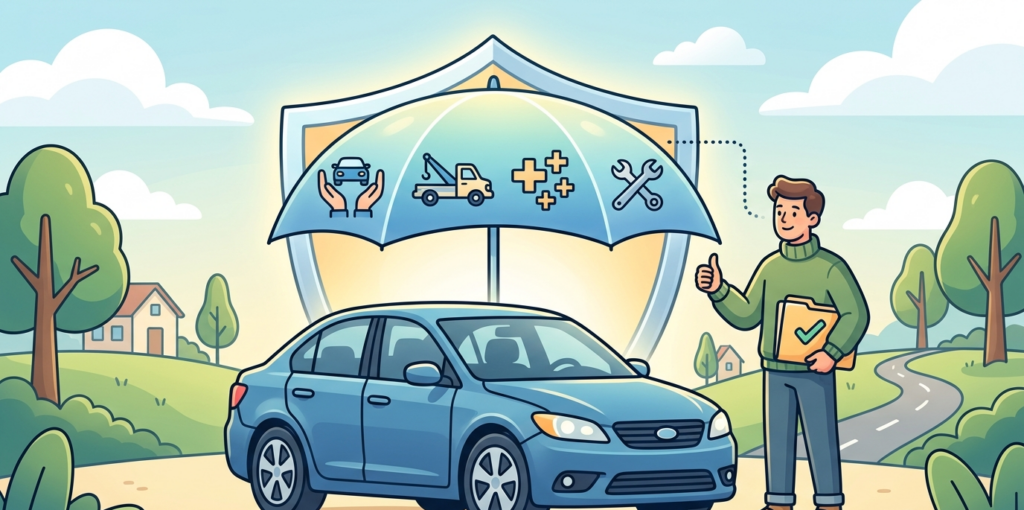
Liability Coverage: The One You Cannot Skip
Liability coverage is the foundation of every car insurance policy. It is required by law in almost every state. If you drive without liability coverage, you are breaking the law and risking serious penalties including fines, license suspension, and even jail time in some states.
But what does liability coverage actually do? In simple terms, liability coverage pays for injuries and damage that you cause to other people. If you run a red light and hit another car, liability coverage pays for the other driver’s medical bills and car repairs. It does not pay for your own injuries or your own car. It only pays for the damage you do to others.
Liability coverage is actually two different coverages bundled into one. Bodily injury liability pays for medical bills, lost wages, and pain and suffering for people you injure. Property damage liability pays for repairs to cars, fences, buildings, or anything else you damage with your vehicle.
Here is a table explaining the two parts of liability coverage in simple terms.
| Coverage Name | What It Pays For | Who It Protects |
|---|---|---|
| Bodily injury liability | Medical bills, lost wages, pain and suffering for people you hurt | Other drivers, passengers, pedestrians |
| Property damage liability | Repairs to cars, buildings, fences, mailboxes you damage | Other people’s property |
Every liability policy has three numbers, like twenty five thousand dollars over fifty thousand dollars over twenty five thousand dollars. The first number is the maximum your policy will pay for one person’s injuries. The second number is the maximum your policy will pay for all injuries in one accident. The third number is the maximum your policy will pay for property damage.
For example, a policy with twenty five thousand dollars over fifty thousand dollars over twenty five thousand dollars will pay up to twenty five thousand dollars for one injured person, up to fifty thousand dollars total for all injured people in the accident, and up to twenty five thousand dollars for property damage.
The problem is that these numbers are too low for most real accidents. A single night in the hospital can cost thirty thousand dollars. A new car can cost forty thousand dollars. If you cause a serious accident with minimum liability limits, you will owe tens of thousands of dollars out of your own pocket. Most experts recommend liability limits of at least one hundred thousand dollars per person, three hundred thousand dollars per accident, and one hundred thousand dollars for property damage.
Collision Coverage: Protecting Your Car From Crashes
Collision coverage pays for damage to your own car when you crash into something. That something could be another car, a tree, a guardrail, a fence, a building, or any other object. If you are driving and you hit something, collision coverage pays to fix your car.
The name collision is very descriptive. If your car collides with something, collision coverage applies. It does not matter who is at fault. If you hit another car, collision covers your repairs. If someone else hits you, their liability coverage should pay for your repairs, but if they have no insurance or not enough insurance, your collision coverage acts as a backup.
Here is a simple way to remember what collision coverage does. Crash into something, collision pays.
Collision coverage is optional in most states. You are not required by law to carry it. However, if you have a car loan or a lease, your lender will require you to carry collision coverage. They want to protect their investment in your car.
The cost of collision coverage depends on your car’s value, your driving record, your age, and your location. For a newer car, collision coverage might cost five hundred to one thousand dollars per year. For an older car worth only a few thousand dollars, collision coverage might not be worth the cost.
Collision coverage comes with a deductible. The deductible is the amount you pay out of pocket before insurance kicks in. If you have a five hundred dollar deductible and your repair costs two thousand dollars, you pay five hundred dollars and your insurance pays one thousand five hundred dollars. Higher deductibles mean lower monthly premiums. Lower deductibles mean higher monthly premiums.
Here is a table showing how different deductibles affect your out of pocket cost in different repair scenarios.
| Deductible | $1,000 Repair | $3,000 Repair | $6,000 Repair | $10,000 Repair |
|---|---|---|---|---|
| $250 | You pay $250 | You pay $250 | You pay $250 | You pay $250 |
| $500 | You pay $500 | You pay $500 | You pay $500 | You pay $500 |
| $1,000 | You pay $1,000 | You pay $1,000 | You pay $1,000 | You pay $1,000 |
| $2,500 | You pay $2,500 | You pay $2,500 | You pay $2,500 | You pay $2,500 |
Choosing the right deductible is about balancing your monthly budget against your savings. If you have one thousand dollars in an emergency fund, a one thousand dollar deductible saves you money each month and you can still afford to pay it if you have an accident. If you have only two hundred dollars in savings, a two hundred fifty dollar deductible is safer even though your monthly premium will be higher.
Comprehensive Coverage: Protecting Your Car From Everything Else
Comprehensive coverage pays for damage to your car that is not caused by a collision. The name is confusing because comprehensive does not mean everything. It means everything except crashes. If you are confused, just remember that comprehensive covers almost everything that is not a crash.
Here is what comprehensive coverage pays for. Theft of your car or parts from your car. Vandalism like keyed paint or broken windows. Weather damage like hail, wind, or falling trees. Fire damage. Flood damage. Hitting an animal like a deer or a dog. Broken windshield or other glass damage. Riots or civil disturbances. Falling objects like tree branches or construction debris.
Here is a simple way to remember what comprehensive coverage does. Collision is crash. Comprehensive is everything else.
Like collision coverage, comprehensive is optional unless you have a car loan or lease. Also like collision coverage, comprehensive comes with a deductible. However, comprehensive deductibles are often lower than collision deductibles for the same policy. Many insurers also offer zero deductible glass coverage, which means your windshield is repaired or replaced at no cost to you.
Here is a table comparing collision and comprehensive coverage side by side.
| Type of Damage | Collision Coverage | Comprehensive Coverage |
|---|---|---|
| Hitting another car | Yes | No |
| Hitting a tree or pole | Yes | No |
| Hitting a deer | No | Yes |
| Car stolen | No | Yes |
| Vandalism | No | Yes |
| Hail damage | No | Yes |
| Fire damage | No | Yes |
| Broken windshield | No | Yes (often $0 deductible) |
One important note about comprehensive coverage is that it often covers your car even when you are not driving. If your car is parked on the street and a tree falls on it, comprehensive pays. If your car is in your driveway and someone steals it, comprehensive pays. If hail damages your car while you are at work, comprehensive pays. This makes comprehensive coverage valuable even for drivers who do not drive very much.
Uninsured and Underinsured Motorist Coverage: Protecting You From Other Drivers’ Mistakes
Uninsured motorist coverage protects you if you are hit by a driver who has no insurance. Underinsured motorist coverage protects you if you are hit by a driver whose insurance limits are too low to cover your medical bills. These two coverages are often combined into a single coverage called UM/UIM.
Here is why this coverage is so important. Nearly one in eight drivers on American roads has no insurance at all. In some states, like Florida, Mississippi, and New Mexico, the rate is closer to one in four. If one of these uninsured drivers hits you and causes serious injuries, you cannot collect from their insurance because they have none. You can sue them personally, but if they cannot afford insurance, they probably do not have assets to collect either. Without uninsured motorist coverage, you are left paying your own medical bills.
Underinsured motorist coverage protects you in a different scenario. Suppose you are hit by a driver who has the state minimum of fifteen thousand dollars in liability coverage. Your medical bills are fifty thousand dollars. Their insurance pays fifteen thousand dollars. You need thirty five thousand dollars more. If you have underinsured motorist coverage, your own policy pays that thirty five thousand dollars. If you do not, you have to pay it yourself or try to sue the driver.
Here is a table showing how UM/UIM coverage works in different accident scenarios.
| Scenario | At Fault Driver’s Insurance | Your UM/UIM Coverage | Who Pays Your Medical Bills? |
|---|---|---|---|
| Driver has no insurance | $0 | $0 (none) | You pay everything |
| Driver has no insurance | $0 | $50,000 | Your policy pays up to $50,000 |
| Driver has $15k limit | $15,000 | $0 (none) | Their $15k, you pay the rest |
| Driver has $15k limit | $15,000 | $50,000 | Their $15k, your policy pays $35k |
| Driver has $100k limit | $100,000 | $50,000 | Their $100k pays everything |
The cost of UM/UIM coverage is surprisingly low. For most drivers, adding fifty thousand or one hundred thousand dollars in UM/UIM coverage costs five to fifteen dollars per month. That small amount buys you protection against one of the biggest risks on the road. UM/UIM coverage is one of the best values in all of car insurance.
Most experts recommend carrying UM/UIM coverage at the same limits as your liability coverage. If you carry one hundred thousand dollars per person in liability, carry one hundred thousand dollars per person in UM/UIM. This ensures that you are protected to the same level that you protect others.
Medical Payments and Personal Injury Protection: Paying Your Own Medical Bills
Medical payments coverage, often called MedPay, pays for your medical bills after an accident regardless of who caused the accident. If you are injured, your MedPay coverage pays for your treatment. It also pays for your passengers’ medical bills and even for your medical bills if you are hit while walking or biking.
Personal injury protection, often called PIP, is similar to MedPay but broader. PIP is available only in no fault states. PIP pays for medical bills, lost wages, rehabilitation costs, funeral expenses, and even household services like childcare that you cannot perform while injured. PIP is more comprehensive than MedPay, but it is also more expensive.
Here is a table comparing MedPay and PIP.
| Feature | MedPay | PIP |
|---|---|---|
| Available in | All states | No fault states only |
| Pays medical bills | Yes | Yes |
| Pays lost wages | No | Yes |
| Pays rehabilitation | No | Yes |
| Pays funeral expenses | No | Yes |
| Pays for household services | No | Yes |
| Typical cost per month | $5-15 | $15-30 |
The biggest advantage of MedPay and PIP is that they pay quickly and without determining fault. With liability coverage, you have to wait for the insurance companies to decide who caused the accident. With MedPay or PIP, you submit your bills and get paid right away. This is especially valuable if you do not have health insurance or if your health insurance has high deductibles.
Even if you have good health insurance, MedPay or PIP is still valuable. Your health insurance will have deductibles, copays, and possibly out of network limitations. MedPay or PIP covers those out of pocket costs. It also covers your passengers, who might not have health insurance of their own.
Most experts recommend carrying at least five thousand dollars in MedPay or the minimum PIP required in your state. The cost is low, and the protection is valuable.
Gap Insurance: Covering the Difference When You Owe More Than Your Car Is Worth
Gap insurance is one of the most misunderstood coverages, but it is also one of the most important for drivers with car loans. Gap stands for guaranteed asset protection. In simple terms, gap insurance pays the difference between what your car is worth and what you still owe on your loan if your car is totaled.
Here is why gap insurance matters. New cars lose value quickly. The moment you drive a new car off the dealer lot, it loses ten to twenty percent of its value. By the end of the first year, your car might be worth only seventy to eighty percent of what you paid. Meanwhile, you still owe the full amount of your loan. If your car is totaled in an accident, your standard collision coverage pays only the current value of the car, not what you owe. If you owe twenty five thousand dollars and your car is worth only eighteen thousand dollars, your insurance pays eighteen thousand dollars and you still owe seven thousand dollars to the bank. Gap insurance covers that seven thousand dollars.
Here is a table showing how gap insurance works in a real example.
| Scenario | Without Gap Insurance | With Gap Insurance |
|---|---|---|
| Your car loan balance | $25,000 | $25,000 |
| Your car’s actual value after accident | $18,000 | $18,000 |
| Collision coverage pays | $18,000 | $18,000 |
| You still owe the bank | $7,000 | $7,000 |
| Gap insurance pays | $0 | $7,000 |
| Total out of pocket cost to you | $7,000 | $0 |
Gap insurance is relatively inexpensive. It typically adds twenty to forty dollars per year to your premium. For drivers with small down payments or long loan terms, gap insurance is an excellent value. For drivers who put twenty percent or more down or who have short loan terms, gap insurance may not be necessary.
You do not have to buy gap insurance from your car insurance company. Car dealers offer gap insurance, often called gap protection, when you buy the car. However, dealer gap insurance is usually much more expensive than adding it to your auto policy. Always compare prices before buying.
Rental Reimbursement and Roadside Assistance: The Convenience Coverages
Rental reimbursement pays for a rental car while your car is being repaired after an accident. If you have this coverage and you are in an accident, your insurance will pay for a rental car for the days or weeks your car is in the shop. Typical limits are thirty dollars per day for up to thirty days.
Roadside assistance pays for services when your car breaks down. If you lock your keys in the car, run out of gas, have a dead battery, or need a tow, roadside assistance covers the cost. This is the same service you might get from AAA or another motor club.
Here is a table comparing these two convenient coverages.
| Coverage | What It Pays For | Typical Cost Per Year | Typical Limits |
|---|---|---|---|
| Rental reimbursement | Rental car while your car is being repaired after an accident | $20-40 | $30/day for 30 days |
| Roadside assistance | Towing, jump starts, lockout service, flat tire changes, fuel delivery | $10-30 | $50-100 per incident |
Both of these coverages are optional and relatively inexpensive. For most drivers, the convenience is worth the small cost. However, if you have a second car in your household that you can use while your car is being repaired, you do not need rental reimbursement. If you already have AAA or another motor club membership, you do not need roadside assistance.
One thing to note is that roadside assistance through your insurance company may count as a claim. If you use it several times, your insurer might increase your rates or even non renew your policy. This is different from AAA, which does not affect your insurance record. For this reason, some drivers prefer to keep their roadside assistance separate from their car insurance.
Putting It All Together: What Coverage Do You Actually Need?
Now that you understand each type of coverage, the question is which ones you actually need. The answer depends on your specific situation, but here is a general guideline for most drivers.
Liability coverage is required and essential. Do not skimp on this. Carry at least one hundred thousand dollars per person and three hundred thousand dollars per accident. The extra cost is small compared to the protection.
Uninsured and underinsured motorist coverage is essential in most states. The risk of being hit by an uninsured driver is too high to ignore. Carry the same limits as your liability coverage.
Medical payments or personal injury protection is highly recommended. The cost is low, and the protection is valuable, especially if you have a high deductible health plan.
Collision and comprehensive coverage depend on your car. If you have a car loan or lease, you need both. If your car is worth more than five thousand dollars, you probably want both. If your car is worth less than three thousand dollars, you can consider dropping them.
Gap insurance is essential if you have a car loan with a small down payment or a long loan term. If you put twenty percent or more down or paid cash, you do not need gap insurance.
Rental reimbursement and roadside assistance are optional convenience coverages. They are inexpensive and nice to have, but you can skip them if you have alternatives.
Here is a summary table of all coverages and whether you probably need them.
| Coverage | Required by Law? | Need if You Have a Loan? | Recommended for Most Drivers? |
|---|---|---|---|
| Liability | Yes | Yes | Yes, at higher limits |
| Collision | No | Yes | If car worth > $5k |
| Comprehensive | No | Yes | If car worth > $5k |
| Uninsured/underinsured | No (in most states) | No | Yes |
| Medical payments/PIP | No (in most states) | No | Yes |
| Gap insurance | No | Highly recommended | If small down payment |
| Rental reimbursement | No | No | Nice to have |
| Roadside assistance | No | No | Nice to have |
The Bottom Line on Car Insurance Coverage Explained Simply
Car insurance coverage does not have to be confusing. There are only a handful of main coverages, and each one protects you against a specific type of loss. Liability pays for damage you cause to others. Collision pays for damage to your car from crashes. Comprehensive pays for damage to your car from everything else. Uninsured motorist protects you if the other driver has no insurance. Medical payments pays your medical bills. Gap insurance covers the difference when you owe more than your car is worth. Rental reimbursement and roadside assistance are convenient extras.
The key is to understand what each coverage does so you can make informed decisions about what to buy. Do not just buy whatever the agent suggests or whatever is cheapest. Think about your specific situation. How much is your car worth? Do you have savings to cover a deductible? Could you afford to replace your car if it was totaled? How much would a medical bill set you back? The answers to these questions will guide your choices.
Start with liability coverage at one hundred thousand dollars per person and three hundred thousand dollars per accident. Add uninsured motorist coverage at the same limits. Add medical payments coverage of at least five thousand dollars. Then decide about collision and comprehensive based on your car’s value. If you have a loan, add gap insurance. If you want the convenience, add rental reimbursement and roadside assistance. This combination gives you strong protection without paying for coverage you do not need.
Now you understand car insurance coverage in simple terms. You know what each coverage does. You know which ones you need. And you know how to make the right choice for your situation. That knowledge will save you money and protect you from financial disaster.